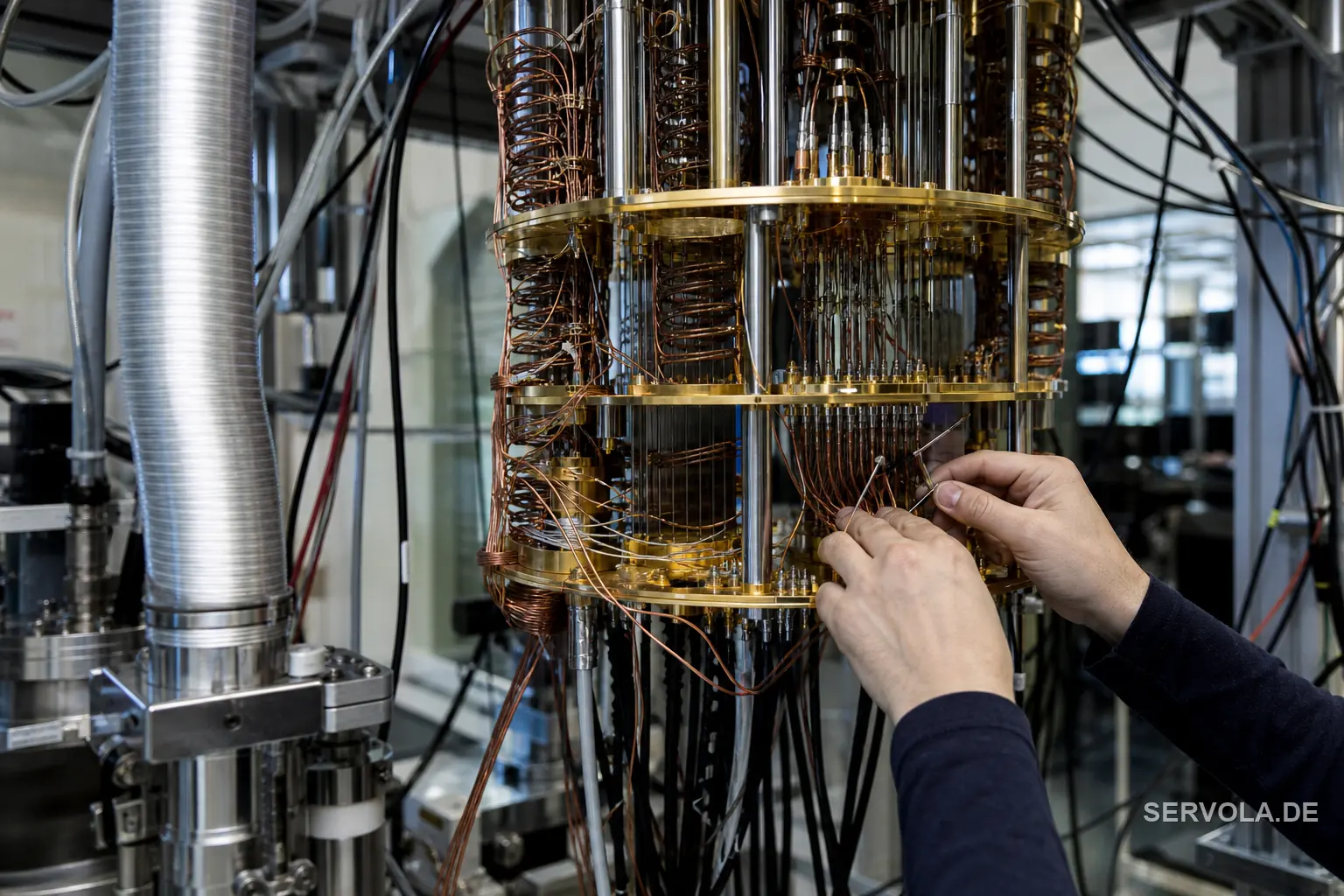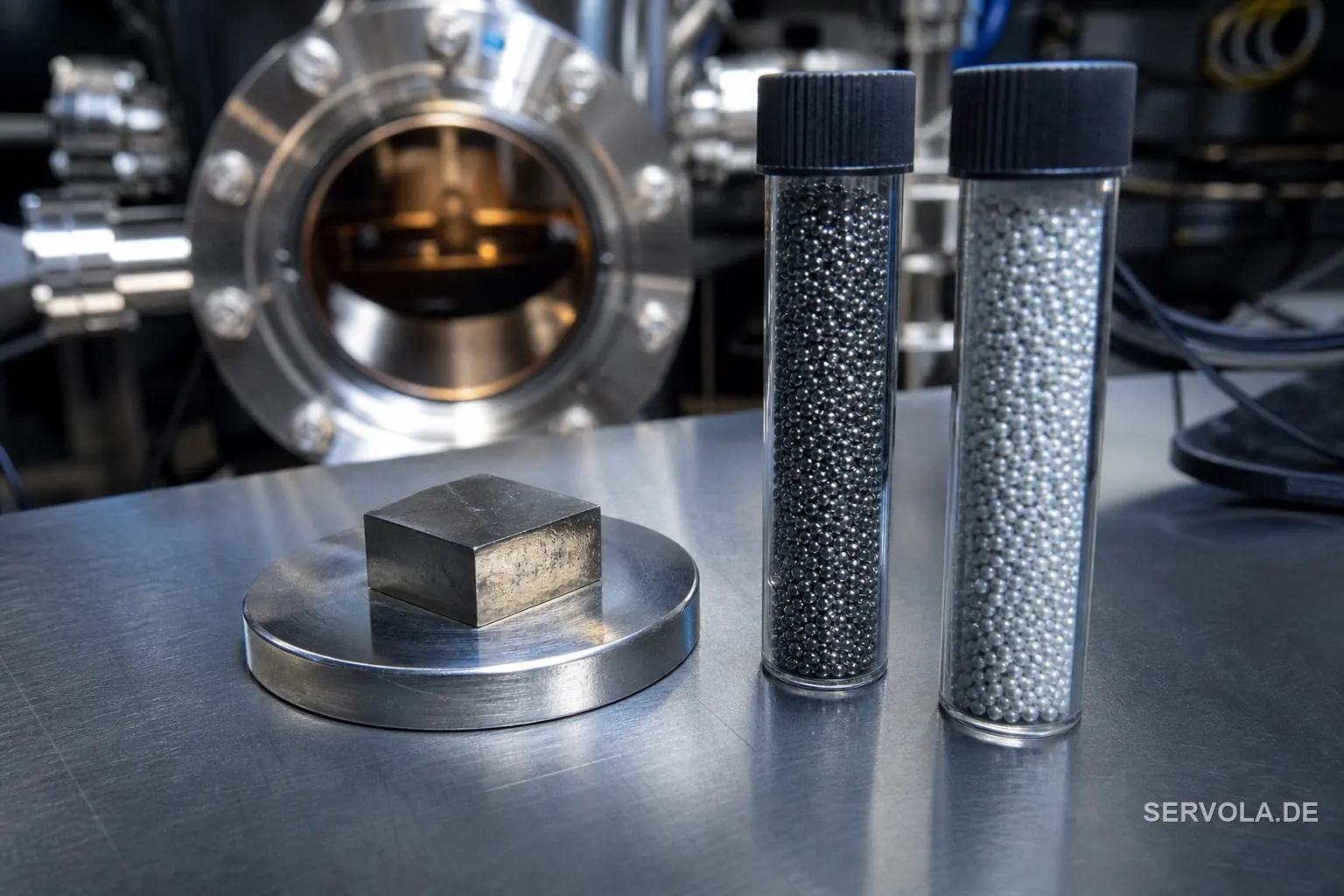
The Fix: Argon Out, Krypton In
Researchers at Cornell University's Fatemi Lab found that switching the sputtering gas used to deposit tantalum films from argon to krypton lets manufacturers reach the same crystal structure at roughly half the temperature. The paper, led by postdoctoral researcher Maciej Olszewski under principal investigator Valla Fatemi, appeared in Nature Materials in August 2026 and is also posted as an arXiv preprint.
Tantalum has become one of the most attractive materials for superconducting qubits because it loses very little energy to microwave resistance, which translates directly into qubits that hold their quantum state longer. The catch was always how to build it. Getting tantalum into the stable body-centered cubic crystal structure, known as alpha-phase, that gives it those properties had required magnetron sputtering at substrate temperatures above 400 degrees Celsius. Standard semiconductor foundry lines cap their process temperatures at roughly 200 to 250 degrees Celsius to avoid damaging the transistors, wiring, and other structures already built into a chip. Tantalum qubits, in other words, needed a furnace that would destroy the rest of the chip around them.
A Foundry Problem Hiding Inside A Physics Story
Most public coverage of quantum computing progress treats the bottleneck as a physics problem: more qubits, lower error rates, longer coherence times. The Cornell result points at a different constraint entirely, one that sits between a working physics demonstration and a manufacturable product.
A material can have excellent physical properties and still be commercially worthless if building it damages everything else on the chip. That is what a 400-degree-Celsius process temperature does inside a modern semiconductor fab: it exceeds the thermal budget of the transistors, interconnects, and control circuitry that a qubit chip needs around it to function as a device rather than a laboratory curiosity. Swapping the process gas from argon to krypton does not change tantalum's physics. It changes how the same alpha-phase crystal forms on the surface, allowing it to stabilize at a lower temperature. That kind of materials-engineering fix rarely makes a splashy headline, because it does not announce a new record. It removes a wall that was standing between a lab result and a foundry line, which is a more useful thing to know if the question is when quantum hardware becomes something a company can actually order and receive.
Before And After, In Numbers
The comparison is straightforward once the two processes sit side by side. Films grown at 250 and 350 degrees Celsius under the krypton process showed a tight, state-of-the-art performance distribution, while films grown at higher temperatures showed more loss, correlated with unwanted mixing between the tantalum and the silicon substrate underneath.
| Measure | Argon Process | Krypton Process |
|---|---|---|
| Process gas | Argon | Krypton |
| Temperature needed for alpha-phase tantalum | Above 400C | As low as 200C |
| Compatible with standard foundry lines (200-250C cap) | No | Yes |
Transmon qubits built with the krypton-sputtered films, using a compact 20-micrometer capacitor gap, reached internal quality factors up to 16.9 million, with a median of 14 million across the best-performing growth temperatures. Quality factor measures how many oscillations a qubit's microwave signal survives before losing its quantum information, so a higher number means a longer-lived, more usable qubit.
Who Did The Work, And Who Paid For It
The 12-author paper was led by Maciej Olszewski, a postdoctoral researcher, working under Valla Fatemi, an assistant professor in Cornell's School of Applied and Engineering Physics and an Aref and Manon Lahham Faculty Fellow. Co-authors include Cornell materials scientist David Muller alongside Lingda Kong, Simon Reinhardt, Daniel Tong, Xinyi Du, Gabriele Di Gianluca, Haoran Lu, Saswata Roy, Luojia Zhang, and Aleksandra Biedron.
Funding came from the U.S. Department of War's Microelectronics Commons Program, the Air Force Office of Scientific Research, and the Cornell NanoScale Science and Technology Facility, which draws National Science Foundation support. Fatemi described the change as deliberately unglamorous. "We figured out a relatively simple change," he said, "to bring that temperature down into a zone that is translatable to nanofabrication systems in industry."
The Signal EU and UK Operators Should Track
Quantum computing timelines usually get discussed through demonstrations of qubit count or error-correction milestones, both of which are physics results that can happen entirely inside a research lab. Fab-compatibility results like this one measure something different: whether a device can actually be built at volume on the equipment a real semiconductor plant already owns.
That distinction matters directly for EU and UK semiconductor strategy under the Chips Act, which is built around expanding domestic fabrication capacity rather than funding more physics papers. A qubit material that needs a 400-degree process is not a candidate for near-term integration into any existing European fab line, however good its physics looks on paper. A qubit material that fits inside a 200-degree thermal budget is. For an operator or investor trying to judge when quantum hardware moves from a lab demo to something procurable, the milestone worth watching is this kind of process-compatibility result, not the next qubit-count press release.
Read next: Europe's Quantum Hardware Now Compiles Through Nvidia | Germany's New Quantum Computer Needs No Deep Freeze