A EUR387.8 Million Contract, Six Governments
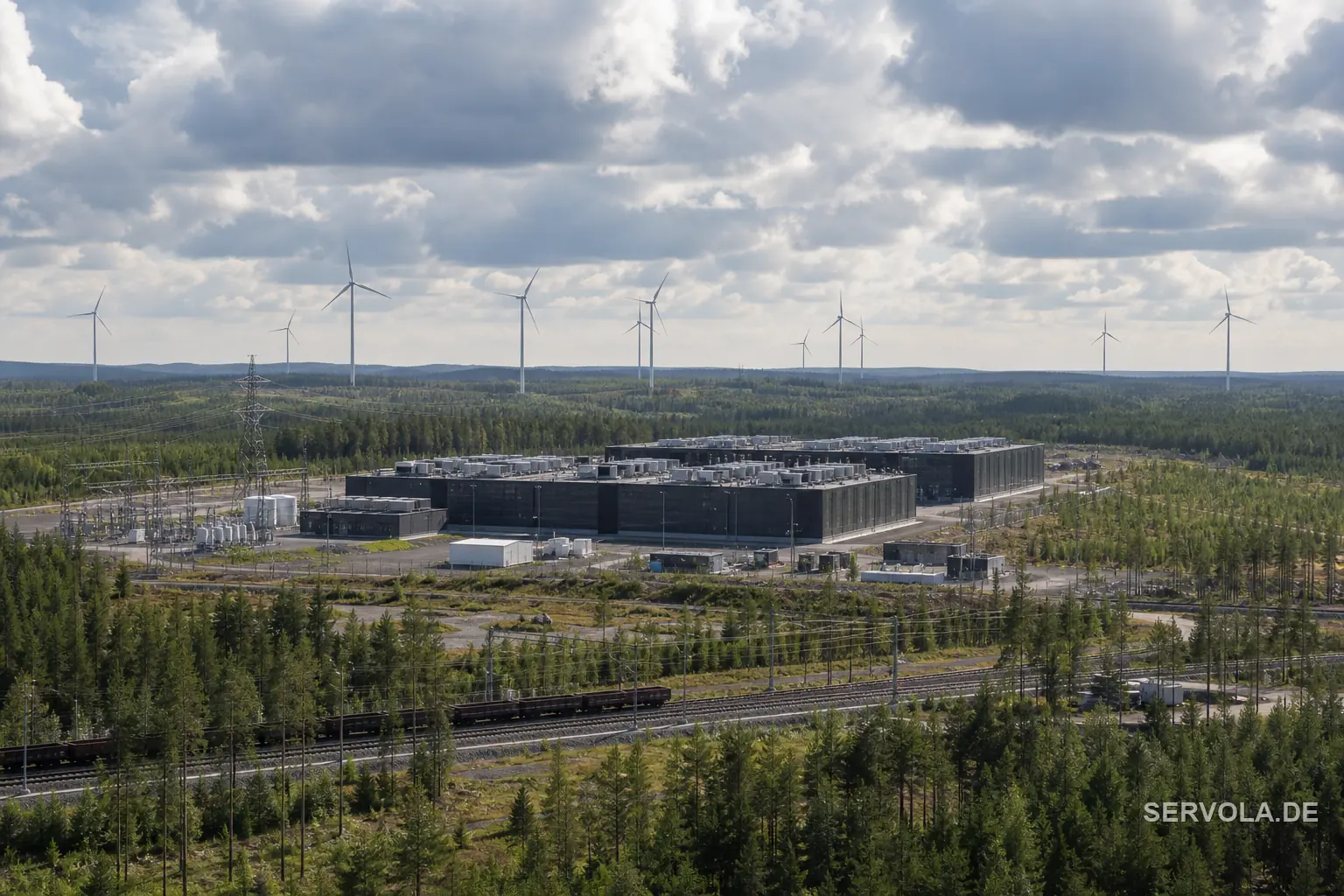
On August 31, 2026, the EuroHPC Joint Undertaking signed a EUR 387.8 million contract with Bull to build LUMI-AI, a supercomputer that will run alongside Finland's existing LUMI system at CSC's data centre in Kajaani. The contract covers acquisition, delivery, installation and maintenance, and folds in a companion quantum computing platform, LUMI-IQ, built by Finland's IQM Quantum Computers.
Six governments - Finland, Czechia, Denmark, Estonia, Norway and Poland - are funding LUMI-AI jointly as the LUMI AI Factory consortium. Deployment is set for the second half of 2027, at which point EuroHPC expects ten times today's AI computing capacity and nearly double today's general HPC capability. For a UK reader, EUR 387.8 million converts to roughly GBP 330 million at recent exchange rates.
The Integrator Changed. The Chip Supplier Did Not.
Today's LUMI already carries a reputation: 10,240 AMD Instinct MI250X GPUs delivering roughly 379 petaflops, widely cited as Europe's fastest supercomputer. It was built by Hewlett Packard Enterprise, an American company, and installed at CSC's Kajaani site in 2021.
LUMI-AI's builder is not American. Bull has been 100 percent owned by the French state since it closed a EUR 404 million purchase of Atos's Advanced Computing division on March 31, 2025 - a deal Paris pushed through specifically because Bull also builds systems tied to France's nuclear deterrent, a role no foreign owner would be allowed to hold. So the integrator moved from the United States to the French state. The chip did not: AMD supplied the GPUs in 2021's LUMI, and AMD supplies the GPUs in 2027's LUMI-AI, this time the newer Instinct MI430X alongside 6th-generation AMD EPYC 256-core CPUs.
What Actually Changes, Machine to Machine
Laid side by side, the two systems show exactly where six years of European sovereignty spending have moved the needle, and where it has not.
| Metric | Current LUMI (2021, HPE-built) | LUMI-AI (from H2 2027, Bull-built) |
|---|---|---|
| System integrator | Hewlett Packard Enterprise (US) | Bull (100 percent French state-owned) |
| GPU accelerator | AMD Instinct MI250X | AMD Instinct MI430X |
| AI computing capacity | Baseline | 10 times baseline |
| Contract value | Not disclosed at this scale | EUR 387.8 million |
What This Means If You Run an EU Business
LUMI-AI is built for multi-tenant, API-based access, and EuroHPC lists AI training and inference and industrial AI innovation among its intended uses, not only academic research. That is a real shift: national supercomputers in Europe have historically been rationed out to universities, not rented to companies.
Nothing is bookable yet - deployment is second half of 2027 at the earliest. But that date is the point at which an EU business finally gets a choice that has so far existed only in policy documents: European-owned, EU-jurisdiction AI compute, funded by six governments, as an actual line item to weigh against a US hyperscaler's EU region. The ownership and the legal jurisdiction differ from a hyperscaler; the chip underneath, for now, does not.
Read next: Dutch Tax Agency Moves Its Mail Off Microsoft 365 | Mistral Large 4 Wins Where Closed Models Refuse