What a Code Channel Actually Does
Slack Code turns AI coding work from a private conversation between one person and an agent into a shared, reviewable channel the whole team can watch.
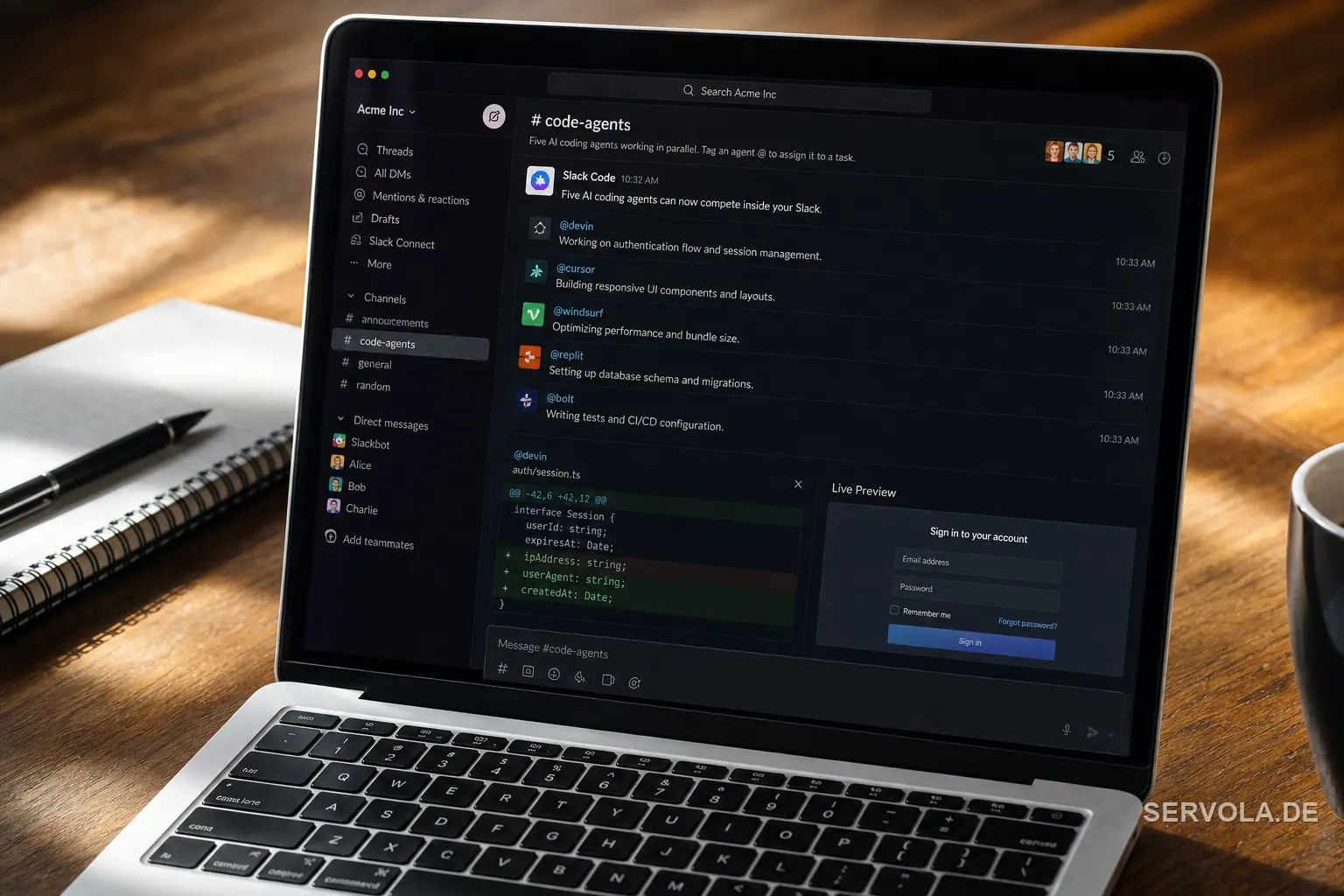
Tag a coding agent from any conversation and it spins up a project-based code channel: everyone in it can follow the conversation, the plan, the code diffs and live previews of the actual output. Diffs render the way engineers already expect, old line struck through, new line beside it, just visible to the whole channel instead of buried in a private tool. When the task is done the channel archives itself automatically, but the record stays searchable as an audit log. For anything high-stakes, like pushing to production, the agent packages its work for a named person to sign off in the channel, so speed does not come at the cost of oversight.
Five Vendors, One Interface, No New Bill From Slack
Slack Code launches with five founding coding-agent partners, and Slack itself does not charge extra for the channels that host them.
| Coding agent | Vendor | What it is |
|---|---|---|
| Claude | Anthropic | AI coding agent, integrated into Slack via Claude in Slack |
| Copilot | GitHub (Microsoft) | AI coding agent, primarily IDE-native |
| Devin | Cognition | Autonomous AI software engineer |
| ChatGPT | OpenAI | General AI assistant with a coding mode |
| Vercel agent | Vercel | AI agent for building and deploying web apps |
Access to each partner agent is required, in Salesforce's own words, meaning a team still pays Anthropic, GitHub, Cognition, OpenAI or Vercel directly for the underlying agent. Slack's layer on top, the code channel itself, is available on any Slack plan at no additional cost for this release.
The Real Shift: Lower Switching Cost, Not Lower Price
The interesting change here is not economic, it is comparative: five agents now sit inside the same interface, so evaluating them stops requiring separate infrastructure for each one.
Previously, picking an AI coding agent was close to a single-vendor bet, since trying a second one meant a second tool, a second login and a second workflow to learn. Inside Slack Code, a team can run the same bug fix through Claude in one channel and Copilot in another without leaving Slack, comparing diffs and previews side by side. That lowers the cost of running an internal bake-off dramatically. What it does not do, at least in this release, is touch the actual price of AI coding: Slack takes no visible cut, so the pricing power stays entirely with the five AI vendors. This is a discovery and evaluation disruption, not a cost disruption, and any business currently locked into one coding agent by inertia rather than by comparison now has a much cheaper way to check whether that lock-in is still justified.
The Governance Question Nobody's Asking Yet
Code channels inherit Slack's existing permissions and admin controls, but the same release also makes it easier than ever to add a completely different, unvetted AI agent to the workspace.
A new "Add to Slack" flow automates OAuth, manifest setup and environment configuration in a few clicks for agents built on NanoClaw, Lovable, Hyperagent, Superhuman, n8n, LangChain, Runlayer or Skydive, and a new Agents tab tracks every agent and every session across the workspace. For a security or IT team working under NIS2 or a general vendor-risk policy, each agent added is effectively a new data processor with its own access to workspace content, and an easy installation is not the same as a reviewed one. The practical move for any EU or UK business piloting Slack Code is to decide now who owns approval for new agents in that Agents tab, before a well-meaning team member adds one over a weekend without anyone else noticing.
Read next: Anthropic Lets You Host Its Mandatory Logs Yourself | Claude's 'New' Enzyme Was Already Known, Experts Say