A Second Record In Four Months
HD Hyundai Heavy Industries announced on August 9, 2026 that it had signed a 956 billion won ($673.8 million) contract with Corban Energy Group, a US energy infrastructure developer, to supply power generation systems for data centers operated by an undisclosed major American technology company. The order covers a combined 1,000 megawatts built from HD Hyundai's 9.6-megawatt HiMSEN engines, medium-speed reciprocating units the company describes as designed for continuous, round-the-clock operation. It is the largest power-generation engine order HD Hyundai Heavy Industries has ever booked.
It did not hold that title for long by comparison to the calendar: the company had set its previous record only four months earlier, in April 2026, with a 627.1 billion won agreement covering 684 MW for Aperion Energy Group (AEG), another US developer. Two record-setting HiMSEN orders inside one financial year, both for American data center power, is the pattern worth noticing more than either number on its own. "The steady stream of collaboration inquiries we are receiving in the data center power generation engine market demonstrates the market recognition of the HiMSEN engine's technological capabilities and reliability," an HD Hyundai official said in the August 9 announcement.
Why a Shipbuilder Is Selling Power Engines
HD Hyundai Heavy Industries builds ships. HiMSEN engines were designed for marine propulsion and shipboard generators, the kind of continuous-duty reciprocating engine that keeps a container vessel running for weeks at sea. That a US data center developer is now buying that catalog by the hundreds of megawatts is a direct consequence of what has happened to the large gas turbine market since AI data center demand took off.
GE Vernova has told investors its gas turbine slots are effectively sold out through 2030, with slot reservations and backlog on track to reach roughly 125 GW by the end of 2026. Siemens Energy is carrying its largest order backlog in company history, close to 70 GW of gas turbine capacity booked. Mitsubishi Power's order book is full into 2028. A developer that needs power now, not in 2030, cannot wait behind that queue, and a large frame or aeroderivative turbine typically takes 3 to 5 years from order to commissioning even once a slot opens up. A reciprocating engine order like Corban's reaches commissioning in roughly 12 to 18 months. That gap, not any claim about efficiency or cost, is the entire reason a shipbuilder's marine engine catalog is now a live option for gigawatt-scale US data center power.
104 Units Nobody Asked to Permit One at a Time
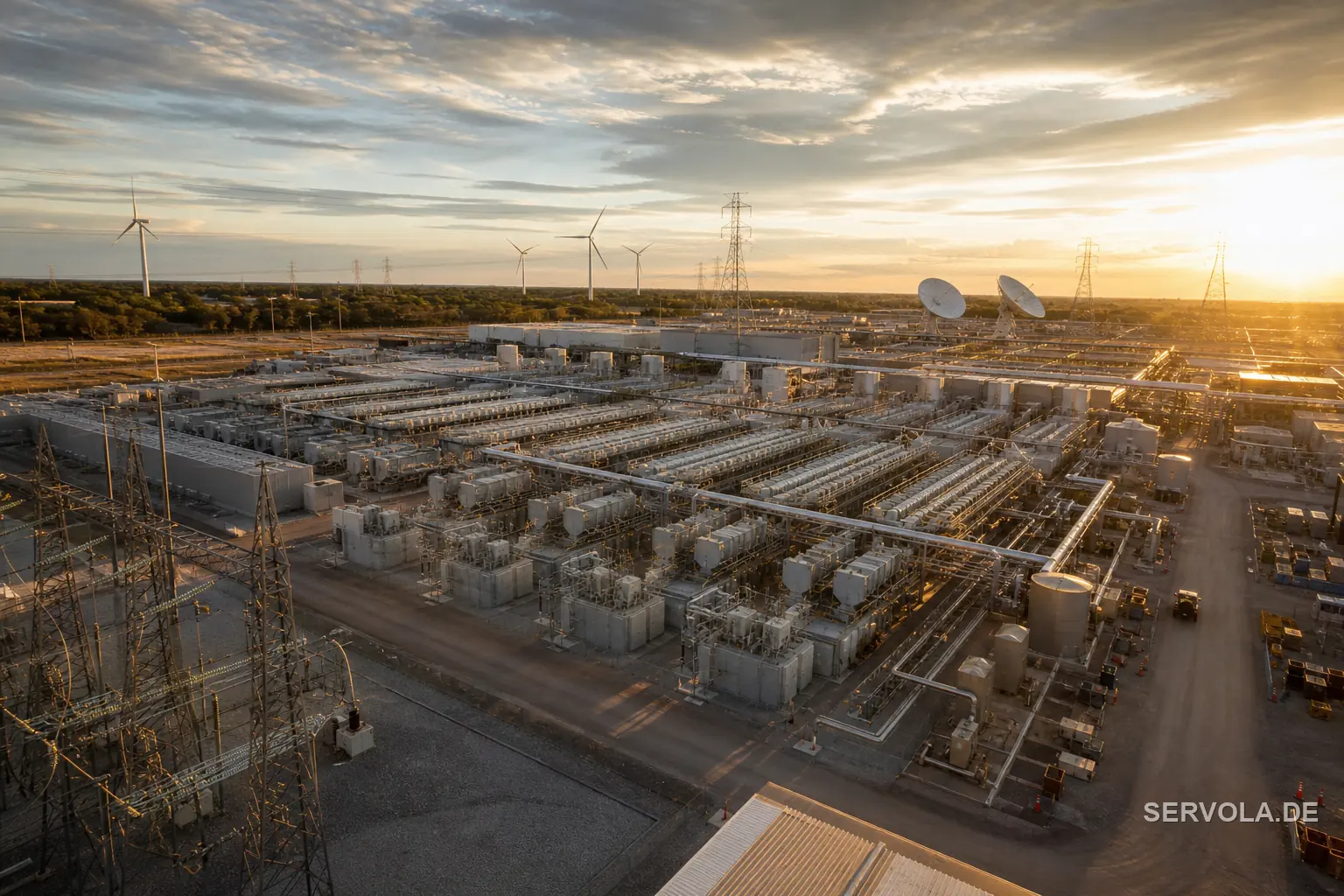
Divide 1,000 MW by 9.6 MW per HiMSEN unit and the deal is not one gigawatt-class plant; it is roughly 104 separate engines. That arithmetic, not stated anywhere in HD Hyundai's or Corban's own announcements, is the physical reality behind the headline figure. A single large turbine concentrates output, maintenance, and permitting into one unit; 104 reciprocating engines spread all three across a site with a much larger footprint, more piping, more wiring, and, in some US jurisdictions, an actual permitting advantage, because each individual engine can fall under emissions thresholds that a single aggregated turbine plant would exceed, even though the total site output and total emissions are comparable or higher. Noise and the sheer number of separate emissions sources on one site are the tradeoffs regulators and neighbors have already raised in other US behind-the-meter gas buildouts.
None of that makes the deal a mistake. It makes it a different kind of infrastructure than the number suggests. A thousand megawatts described as "HiMSEN engines" is not interchangeable, operationally or in maintenance planning, with a thousand megawatts described as one large gas turbine, even though both numbers appear identically in a press release.
The Concentration Risk Behind the Workaround
The turbine bottleneck is real and the reciprocating-engine workaround genuinely solves the timeline problem it was built to solve. What it creates instead is a narrower kind of supplier risk. Two consecutive record-breaking orders from HD Hyundai in four months, for two different US developers building for two different hyperscale customers, means a growing share of new American behind-the-meter gas capacity for data centers now routes through one shipyard's production schedule and one engine platform's parts and service network, built originally to support vessels calling at ports, not campuses running continuously for a decade. A production delay, a labor dispute, or a supply constraint at HD Hyundai's own yards would now touch two separate US data center power programs at once, not one.
The transferable question for any operator or grid planner, in the US or in Europe, watching turbine lead times stretch past 2028, is whether solving a multi-year turbine queue by concentrating orders in a single alternative supplier's catalog is diversification or simply a different, less visible single point of failure. European buyers facing the same Siemens Energy and Mitsubishi Power backlogs will face the identical choice, and the same arithmetic, roughly 100 engines per gigawatt, applies wherever a reciprocating-engine order of this scale gets signed.
Read next: Google Put Four AI Chips in Orbit, Not a Data Center | The Clause That Just Saved Oracle Is In Your Contract