A National AI Champion Built on a Foreign Base
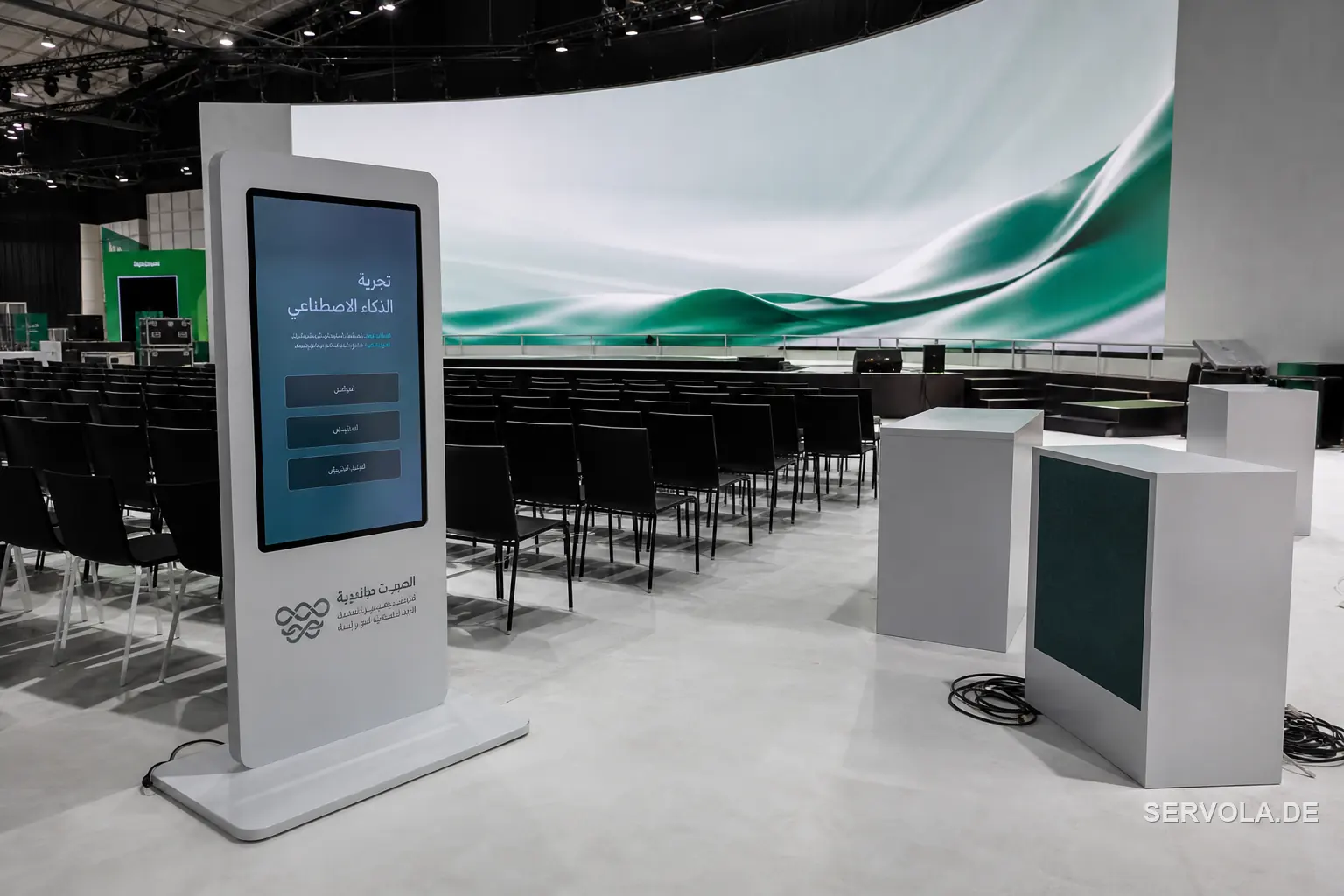
HUMAIN, the Saudi artificial intelligence company backed by the kingdom's Public Investment Fund, announced humain-m3 on September 3, 2026, at the LEAP technology conference in Riyadh. The model is a 428-billion-parameter mixture-of-experts system, and HUMAIN says it achieved the highest average score among frontier models tested across seven public Arabic-language benchmarks.
The detail that separates this launch from a routine model release is what humain-m3 is built on. HUMAIN did not train an Arabic model from a blank slate. It commissioned MiniMax, a Chinese AI company, to deliver a model built on the MiniMax-M3 lineage, then further pretrained that base on more than one trillion tokens of Arabic-native content. HUMAIN CEO Tareq Amin framed the goal in terms of representation: "Arabic is spoken by hundreds of millions of people, yet it remains significantly underrepresented at the frontier of artificial intelligence."
Research Preview Now, Open Weights Next Month
humain-m3 is live today as a research preview on HUMAIN Node, the company's own hosting platform, reachable at node.humain.com. HUMAIN has said the full model weights will follow next month, released publicly under the MiniMax Community License once safety training is complete.
That licensing detail is not a footnote. A model marketed as the flagship of a national, PIF-funded AI strategy will ship its most consequential technical layer, the trained weights themselves, under terms set by a foreign company's license, not a Saudi one. HUMAIN controls the data pipeline, the hosting, the safety pass, and the go-to-market. It does not control the license that governs the underlying architecture and weights it built on.
Sovereignty Is a Stack, Not a Label
The instructive part of humain-m3 for anyone outside Saudi Arabia is not the Arabic-benchmark result. It is what the launch reveals about what "sovereign AI" actually means once a real national program has to ship a product. Sovereignty over an AI system splits into separate layers: who trained the base weights, who owns the license those weights ship under, who holds the fine-tuning data, who runs the safety evaluation, who controls the hosting infrastructure, and who decides distribution and pricing.
HUMAIN holds four of those five layers. It does not hold the first one, the base architecture and weights, which came from a company headquartered in a strategic rival to its largest security partner, the United States. That is not a contradiction HUMAIN is hiding; it is the shape every fast-moving national AI program is likely to take, because building frontier-grade base weights from nothing takes years that a launch calendar does not allow.
A Question the EU's Own Sovereign-AI Projects Should Answer
Al-Monitor's reporting frames the MiniMax partnership as part of a deliberate dual-track strategy: Saudi Arabia is deepening its AI relationship with China while simultaneously pursuing major technology partnerships with the United States, rather than picking a single bloc. Whether or not a European government or vendor would choose the same trade-off, the underlying test applies equally to any program marketed as "sovereign AI," including the EU's own efforts to build homegrown large language models.
A European buyer, regulator, or journalist evaluating a sovereignty claim, whether it comes from Riyadh, Paris, or Brussels, should ask the same five-layer question humain-m3 answers for Saudi Arabia: which layer is actually domestic, and which layer is a dependency wearing a national label. A model can be genuinely sovereign in deployment and genuinely dependent in its base weights at the same time, and a headline that says "sovereign" without naming the layer is describing a marketing claim, not an architecture.
What to Watch Next
The near-term test is the open-weight release HUMAIN has promised for next month. Once the MiniMax Community License terms are public alongside the actual weights, outside researchers will be able to verify how much of humain-m3's behavior traces back to MiniMax's original training versus HUMAIN's Arabic-language fine-tuning, and whether that license carries any restriction that a Saudi state-linked deployment would need to navigate.
Until then, humain-m3 stands as the clearest public example this year of a state-backed AI program treating the base model as a component to be sourced, not a capability to be built, while still calling the result sovereign. Every government running a similar program, in Europe or elsewhere, is making the same layer-by-layer trade-off; humain-m3 is simply the one that put its sourcing decision in the announcement instead of the fine print.
Read next: Mistral Builds Saudi Arabia's Sovereign AI Stack | Europe Just Merged Its Way Down to Two AI Vendors