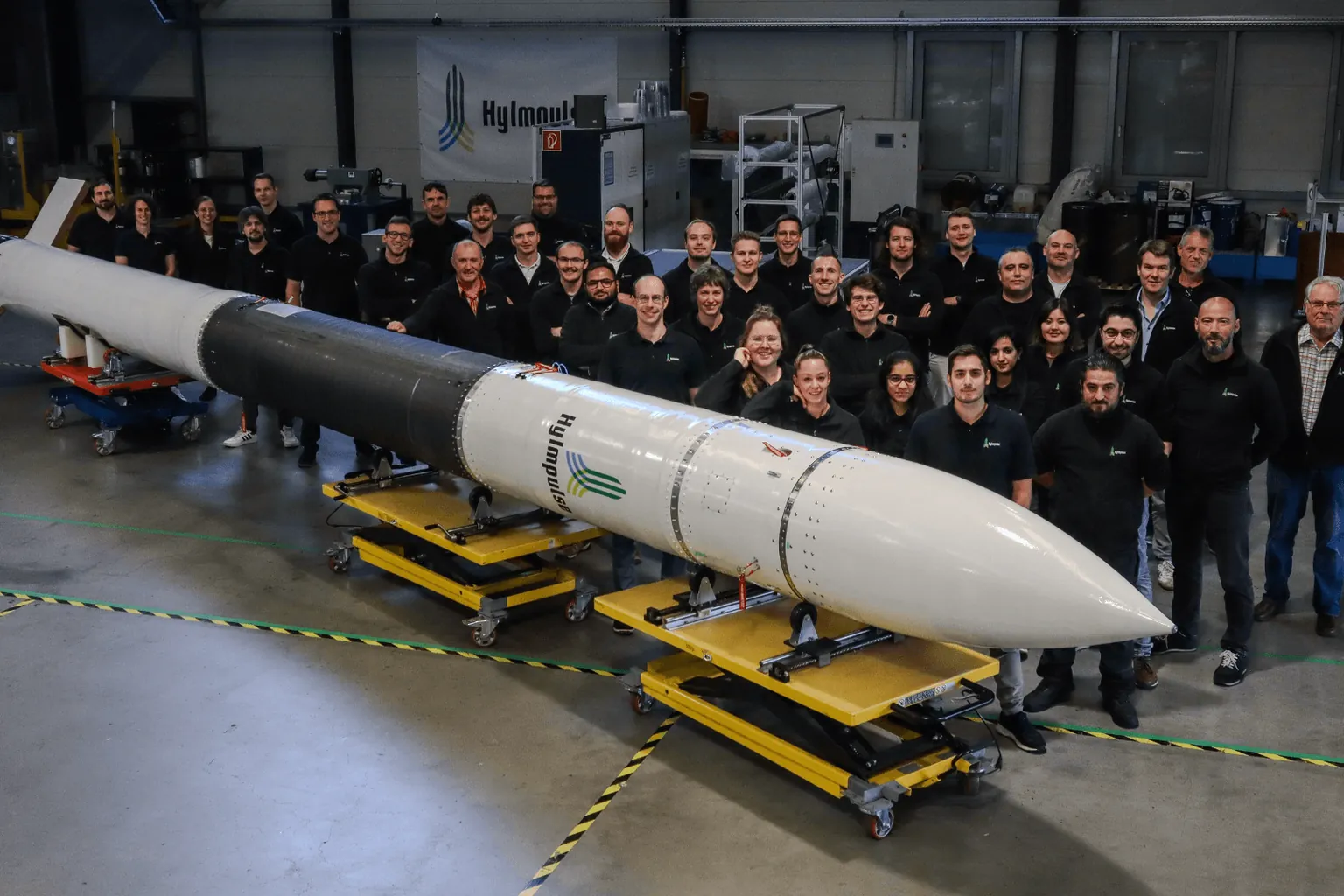
A Round Built for a Company That Already Has Customers
HyImpulse Technologies GmbH announced on 2 September 2026 a Series A Extension of more than EUR50 million in equity, co-led by JOIN Capital and Ace Capital Partners. New investors North Ventures, BW-Capital, Bayern Kapital, and the German Aerospace Center, DLR, joined the round, alongside continued backing from existing shareholder Campus Founders Ventures, according to the company's own press release and independent coverage from tech.eu.
The round brings HyImpulse's total equity and public funding to more than EUR125 million, and the company points to an order book of more than EUR350 million across its suborbital and orbital programs as the reason investors were willing to write checks now rather than wait for a maiden orbital flight. A company with more than a hundred employees and a backlog seven times its lifetime funding is not raising money to prove a concept; it is raising money to deliver contracts it has already signed.
Why a Government Research Agency Buying Equity Is the Real Story
DLR appearing on this cap table as an equity investor, not as a grantor or a contract customer, is the détail that separates this round from routine European space-tech funding news. Government aerospace agencies write research grants and procurement contracts constantly; DLR taking a direct equity stake in one company's Series A Extension is a différent and sharper kind of commitment, because it puts a portion of the agency's own balance sheet behind a specific commercial architecture rather than behind aerospace research broadly.
That distinction matters because grants and contracts are structured to be technology-neutral and are awarded to keep multiple approaches alive; an equity stake is a bet on one company's specific hybrid-propulsion design winning out. Jan Borgstadt of JOIN Capital, one of the round's co-leads, framed the underlying logic as economic as much as technical, describing HyImpulse's roughly half-parts architecture as a path to roughly half the cost per kilogram and far less capital required to reach orbit, which is the kind of claim a state research agency does not attach its own money to lightly.
A German-British Launch Capability, Not a National One
HyImpulse is not building sovereign launch capacity inside one country's borders; it is building it across two, with 100+ employees split among Neuenstadt and Ottobrunn in Germany and an actual operating site in Glasgow, Scotland. The funding accelerates a second SR75 suborbital launch from SaxaVord Spaceport in Shetland, Scotland, by the end of 2026, following SR75's inaugural flight campaign at the Koonibba Test Range in South Australia in 2024, and the round also funds preparation for the maiden flight of the orbital SL1 launch vehicle.
HyImpulse's hybrid propulsion pairs non-explosive paraffin fuel with liquid oxygen, a combination the company presents as safer and cheaper to operate than conventional kérosène-fueled systems. SR75 itself targets speeds up to Mach 15 and ranges up to 10,000 km, serving government agencies, research organizations, and defense customers who need hypersonic testing and threat-simulation capability, a customer base that sits squarely inside the UK and German defense establishments already co-investing in the company.
| Figure | Amount |
|---|---|
| This Series A Extension | Over EUR50 million |
| Total equity and public funding to date | Over EUR125 million |
| Order book (suborbital and orbital) | Over EUR350 million |
| Global commercial launch market by 2035 | USD32 billion (projected) |
What This Signals to EU and UK Space-Adjacent Suppliers
For satellite operators, defense-sector buyers, and suppliers feeding into the European and UK space industry, this round is a signal about which hybrid-propulsion vendor now carries both private-capital conviction and a state research agency's own capital behind it at the same time. The press release itself frames the round as strengthening Europe's and NATO's independent, resilient access to space amid geopolitical tensions and growing defense-sector demand, language that has become common across the sector but is here backed by an actual equity check from a national aerospace agency rather than a policy statement.
The pattern worth watching is not limited to DLR or to HyImpulse. When a national research agency moves from funding research broadly to taking a direct stake in one commercial architecture, it is signaling a conviction that adjacent suppliers, satellite operators, and defense buyers can read as a forward indicator of where procurement and partnership decisions are likely to concentrate, and owners in comparable supply chains should watch for other state R&D agencies making the same kind of move rather than treating this as a one-off.
Read next: Elisity Goes to IonQ for Up to $1.3B in Stock | Character.AI Filed for Chapter 11 and Could Shut Down