A three-day strike that stopped the line for twelve hours
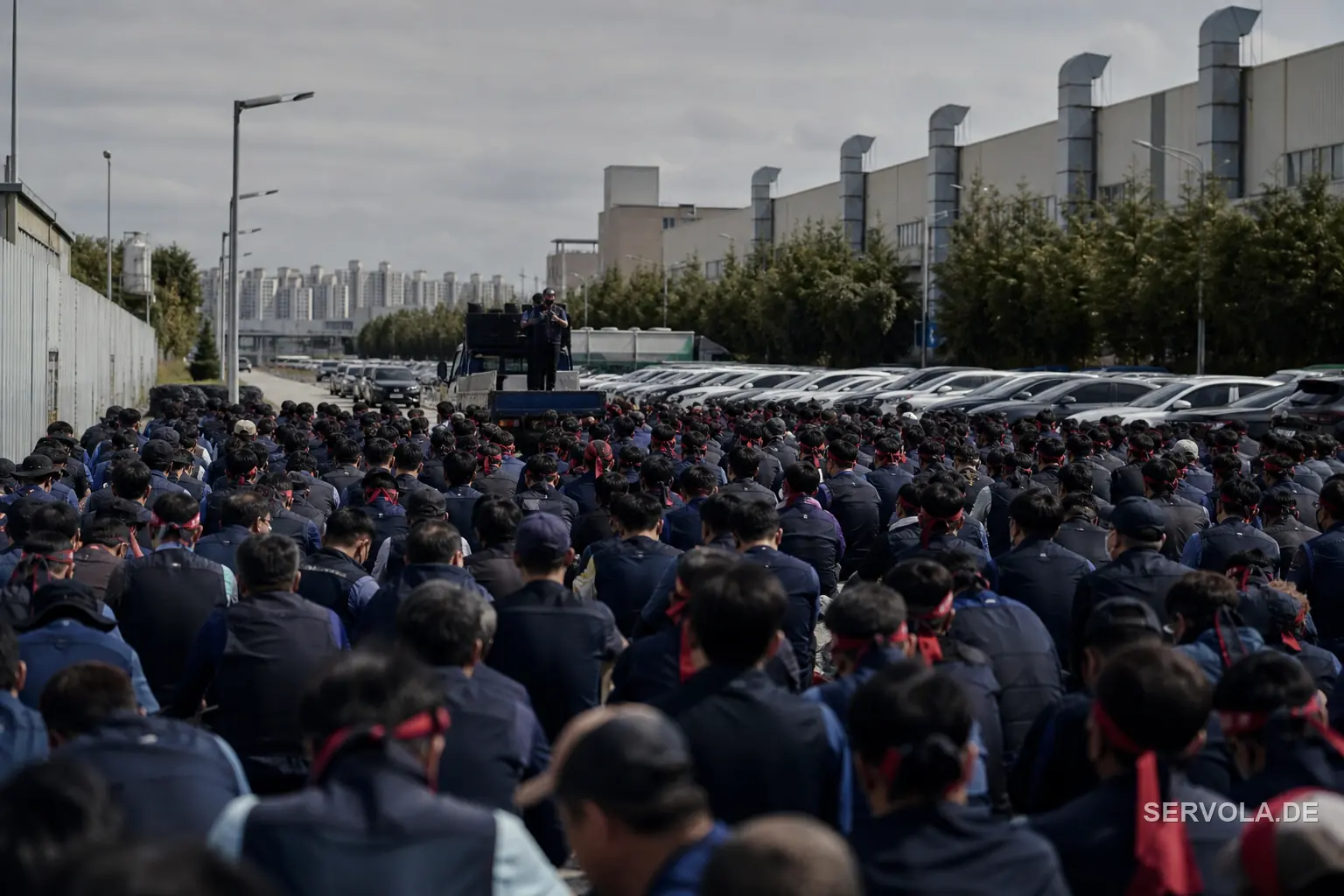
Hyundai's union walked out on 13 July 2026, and then walked back in. The Korean Metal Workers Union branch at Hyundai Motor ran a partial strike across 13, 14 and 15 July: two hours per shift, day and night, up to four hours a day, roughly twelve hours of stopped production in total. Workers left early and worked the rest of the shift. Korean press put the revenue impact around 200 billion won, which is press arithmetic rather than a company figure. Describing this as a three-day strike is technically true and practically misleading, and the difference is exactly the kind of thing that ends up in a board paper as a risk estimate.
The mandate behind it was real. The union has 39,668 members, and 86.65% of them voted for industrial action, which is 92.03% of the ballots actually cast. Those two percentages get swapped in coverage constantly. The lower one is the one that means something.
What they were striking over was mostly not robots. The demands led with a performance bonus set at 30% of the prior year's consolidated net profit, base pay, a shift from the hourly system to a full monthly salary system, and retirement at 65 instead of 60. Hyundai's rejected offer was 89,000 won on base pay, 350% of monthly salary plus 10 million won, and fifteen shares. Job guarantees against Atlas and AI were one item on a list. The 15 July action also coincided with a wider metalworkers' general strike, so that day was not purely a Hyundai dispute. Choi Yeong-il, who runs domestic production, told workers that past strikes had yielded nothing but irreversible production losses, lost wages and harsh criticism from customers and the public.
The clause the union already had
Here is the fact that reorders the whole story: the robot clause was agreed on 2 July, eleven days before the strike began. At the twelfth wage bargaining session, Hyundai accepted language requiring that matters linked to employment, including new-business development and workforce operation, be consulted with the union. Coverage at the time reported it as Hyundai accepting the union's demand on robots. If that were what happened, the union won on 2 July and then struck on 13 July over something it had already won.
It is not what happened. Korean labour practice distinguishes three levels of obligation, and the entire dispute lives in the gap between them. Tongbo means notify: the company decides and tells you afterwards. Hyeop-ui means consult: the company must discuss with you, and may then proceed regardless. Hap-ui means consent: you can withhold agreement, which is a veto in everything but name. Hyundai conceded hyeop-ui. It did not concede hap-ui. Two Korean outlets covering the session said so plainly, one noting that the headline overstated the substance because the provision carries a duty to discuss without any decision-making power.
The union's own slogan gives the game away. Its position, stated in a January press release, was that not a single robot should arrive without labour-management agreement, and that overseas production transfers and automation were one-sided moves made without it. That is a demand for hap-ui, issued because the union does not have it. There was no January agreement, only a January demand. The confirmation is over at Kia, where the union's 2026 bargaining proposal asks to upgrade its own clause from notify to consult. Across the group, the baseline is notify, and even consultation is an aspiration.
The robots are scheduled where the union is not
Now the jurisdictional problem, which is worse for the union than the wording. Hyundai's own announcement at CES 2026 laid out where Atlas goes first: Metaplant America at Ellabell, Georgia, in 2028, starting with parts sequencing, moving to component assembly by 2030, with Kia's Georgia plant following in 2029. Capacity is stated at 30,000 units a year by 2028, with more than 25,000 units eventually deployed across Hyundai and Kia plants in the United States and overseas. No Korean plant is named in any published deployment schedule.
Metaplant is not organised. The United Auto Workers has an organising campaign in the American South and has filed unfair labour practice charges against Hyundai, but there is no certified bargaining unit at the Georgia site. So the union that holds the consultation right has no standing at the plant where the robots actually land, and the plant where the robots land has no union to consult. Whatever hyeop-ui is worth in Ulsan, it is worth nothing in Ellabell.
Hyundai's CES release, which runs to considerable length about Atlas, does not mention unions, labour or job impact at all. Zachary Jackowski, who runs Atlas at Boston Dynamics, was quoted there saying the convergence of robotics and AI is a transformative innovation that will make human life safer and more enriching. That is the company's framing and it is entirely consistent with the deployment map. The robots are going somewhere the question does not have to be answered.
Owning the maker is not the same as owning the timing
Meanwhile the ownership is changing, and not because Hyundai reached for it. SoftBank is exercising a put option to sell its remaining 9.65% of Boston Dynamics for a reported 325 million dollars, disclosed on 16 July, with the contractual window closing on 20 July. The transaction is pending, not complete. SoftBank pushed; Hyundai did not pull. Any account of this as Hyundai mounting a buyout has the agency backwards, and the motive on the other side is ordinary enough: SoftBank is redirecting capital toward its AI infrastructure commitments.
The resulting cap table is worth seeing, because Hyundai Motor does not own Boston Dynamics on its own. Hyundai Motor holds 28%, chairman Chung Eui-sun holds 22.6% personally, Kia 17.2%, Hyundai Mobis 11.3%, Hyundai Glovis 11.25%, and SoftBank the 9.65% now leaving. Ownership of the robot maker sits across a group and a person, which is a different governance object from a subsidiary.
Resist the arithmetic everyone will do. 325 million dollars for 9.65% implies a valuation near 3.4 billion, and that number is not Hyundai's, not SoftBank's, and not stated anywhere. Put-option prices are typically formula-based, agreed years earlier, and not marked to the market of the day. Comparison for scale: Hyundai paid roughly 880 million dollars for 80% in 2021. Be equally careful with the investment figures in circulation. The widely quoted 21 billion dollars is stale, superseded by 26 billion for 2025 to 2029, and neither is a robotics budget. In the original, 6 billion covered autonomous driving, robotics, AI and advanced air mobility combined. There is no published Atlas-specific investment number, and anyone printing one has made it up.
Price the agreement before you price the robot
The transferable lesson is about base rates, and it cuts against the intuitive one. If you are planning automation and your mental model is that organised labour can stop it, Hyundai is the wrong evidence for that belief. The most militant, most experienced automotive union in a heavily unionised country, in its second consecutive year of strike action, has secured a right to be consulted, at plants where the machines are not scheduled, while the machines go to a site where it has no standing. That is the ceiling, not the floor.
The corollary is that the real fight is somewhere else, and Hyundai has already found it. Under an hourly wage system, robots working means fewer human hours, which means lower pay. That is why the union's live demand is the full monthly salary system rather than a deployment veto. It is the money, not the machine. On 8 July the two sides agreed to form a joint task force and a research study, deferring the substance to the 2027 bargaining round. The robot question was not settled. It was postponed, which is what both parties wanted.
So when the next headline says a workforce has won a say over automation, do two things before it reaches your model. Find the verb: notify, consult, or consent, because only the third one stops anything. Then find the jurisdiction: an agreement binds the sites it covers and no others, and capital deploys to where the friction is lowest. An automation plan built on the assumption that someone else's labour agreement will slow your competitor down is a plan resting on a right that, in the leading case, does not exist.
Read next: Claude Now Leads 26 Percent of Its Own Research | Banks Trust SoftBank's OpenAI Bet. Its Stock Doesn't.