What Nvidia Quietly Shipped
On 21 July 2026 Nvidia published a white paper and a set of unofficial benchmark results for Vera, the CPU that sits beside its Rubin accelerators in the next generation of AI servers. The number that travelled fastest was a SPEC CPU 2026 integer score of 925 for a dual-socket Vera against 898 for AMD's flagship EPYC 9755 - a lead of roughly three percent. That number is the least interesting thing in the document.
The interesting part is what Nvidia changed underneath it. Vera is the first Nvidia server processor built on a core the company designed itself, and once you see that, the benchmark reads less like a scoreboard and more like a cover story. What matters for anyone buying or renting large AI compute is not whether Vera wins by three percent. It is that the CPU has quietly stopped being a component you get to choose.
The Core Is Now Nvidia's, Not Arm's
Nvidia's previous data-centre CPU, Grace, used Arm's off-the-shelf Neoverse V2 core - the same design many other vendors license straight from Arm. Vera drops that. Its Olympus core is Nvidia's own microarchitecture, its first custom CPU core, still compatible with the Armv9.2 instruction set so existing software runs, but no longer Arm's design. Nvidia now pays Arm for the instruction set, not for the core, which is the cheaper of the two licences and the one that hands the chipmaker full control of the design.
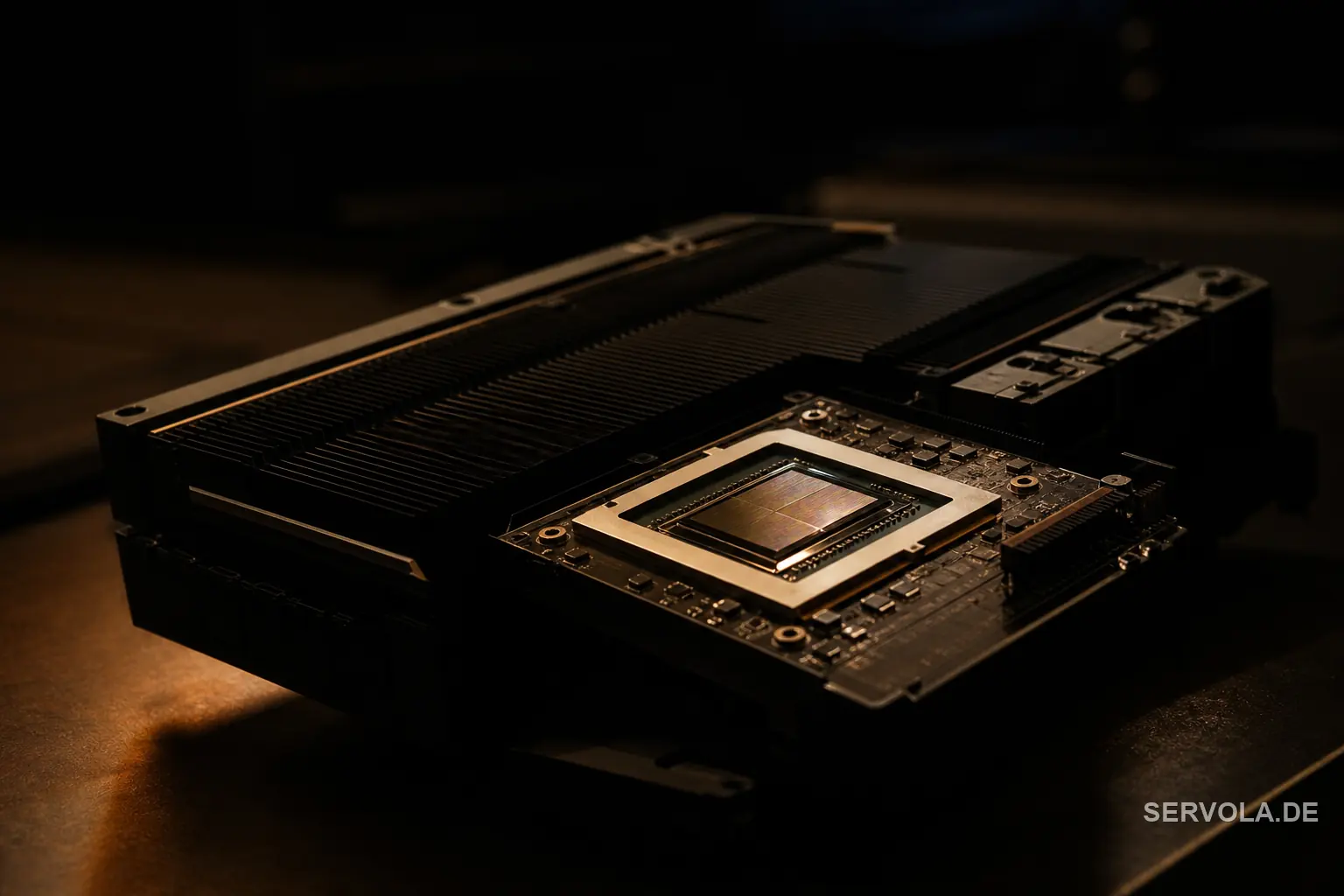
The specifications back a serious effort rather than a badge-swap. Vera carries 88 Olympus cores and 176 threads through Nvidia's spatial multithreading, 164 MB of shared L3 cache, and a SOCAMM2 LPDDR5X memory system rated at up to 1.2 TB per second. The core uses a wider instruction decoder than AMD's Zen 5, Intel's Granite Rapids, and Arm's own Neoverse V2. Nvidia's stated reason is workload-specific: agent pipelines are branch-heavy and jump around in control flow, and off-the-shelf Arm cores were not tuned for that.
So the headline is not a faster chip. It is a shift in who owns the design. Every layer of a Rubin rack that used to involve a third party - the GPU, the interconnect, the networking, and now the CPU core - is Nvidia's own intellectual property.
Why the Benchmark Is a Distraction
Treat the three percent with care. The SPEC CPU 2026 result is self-published, marked unofficial, and measured against one AMD configuration; independent reviewers even flagged errors in Nvidia's own architecture diagram. A margin that thin, released by the vendor that built the chip, is not the reason anyone will run Vera.
The reason is that Vera is not sold on its own. You cannot order it the way you order an EPYC or a Xeon and drop it into a board of your choosing. It ships welded to Rubin GPUs inside Nvidia's rack, sharing coherent memory over NVLink at a bandwidth no third-party CPU can match. Vera does not have to beat AMD in the open market, because it never meets AMD in the open market. It only has to be the CPU that is already in the box.
The Slot You Could Still Shop Is Gone
For years the host CPU was the one part of an AI server where a buyer still had leverage. Even in a machine full of Nvidia GPUs, the processor beside them could be Intel or AMD, and that choice was a small lever on price and a hedge against a single vendor. Grace already narrowed that lever by putting an Nvidia-branded Arm chip in the flagship racks. Vera closes it: the core itself is now Nvidia's, tuned for Nvidia's GPUs, inside Nvidia's rack. A European operator commissioning a sovereign-cloud or colocation build in 2026 is committing tens of millions of euros to a stack where even the CPU vendor is no longer a decision.
The dependency is both commercial and technical. Commercially, fewer independent suppliers sit in the rack to be played against each other on price. Technically, the CPU is co-designed with the GPU, so the performance you are paying for only appears when the whole Nvidia stack is present - which makes mixing in anything else not just unattractive but slower. Even Arm, the UK-headquartered licensor that used to sit in the critical path of your host CPU, now supplies only the instruction set.
How to Price It
Do not evaluate Vera as a CPU purchase, because it is not one. Evaluate the Rubin rack as a single unit and ask what the fully integrated Nvidia stack costs per unit of useful work over the life of the contract, not what the CPU scores in isolation. When you sign a multi-year compute commitment, model the single-vendor risk explicitly: what your renewal price looks like when there is no second CPU source to quote against, and what your exit looks like if you want to leave.
Then read the design intent as a forecast. Nvidia spent the money to build a custom core because it believes host-CPU responsiveness, not just raw GPU throughput, will gate how well agent workloads run. If your 2027 roadmap leans on long-running agents making many sequential tool calls, that signal is worth more to your planning than the three percent ever will be.
Read next: Nvidia Gets Efficient. The Grid Still Doubles. | 15 Percent More: Bloomberg Says Nvidia Warned Its Biggest Cloud Customers