What opened in Dresden, and why the numbers matter
Infineon Technologies switched on its Smart Power Fab in Dresden on 2 July 2026, several months ahead of schedule and at a cost of about 5 billion euros, roughly 5.7 billion dollars. By Infineon's own account it is the largest single investment in the company's history and one of the largest investment projects in Germany, and it stands as the world's largest fab for intelligent power semiconductors and analog and mixed-signal technologies. For an industry that measures new capacity in years, opening early is itself the headline.
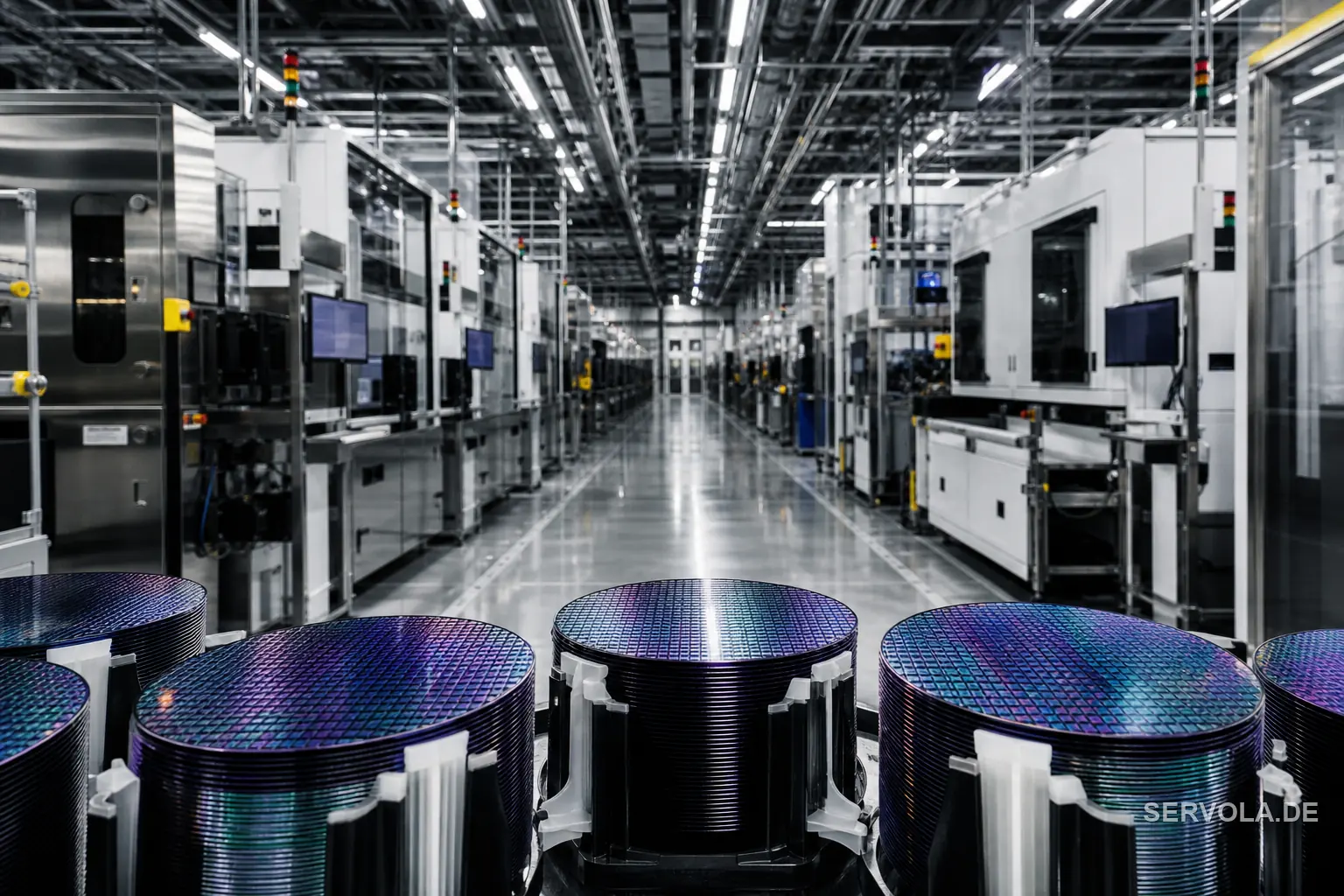
The plant runs on 300mm wafers and doubles Infineon's 300mm manufacturing capacity at the Dresden site, adding around 1,000 direct jobs in Saxony. Its output is not consumer chips but the power semiconductors and analog and mixed-signal parts that feed AI data centres, electric vehicles, renewable energy and industrial systems. That is a deliberate bet on the four end-markets that are growing fastest and running shortest on the exact silicon this fab makes.
The bottleneck nobody names is power silicon, not the GPU
The scarce layer in the AI and electrification build-out is power semiconductors, not the graphics processors that get the attention. Every AI server rack, every electric vehicle and every solar inverter depends on power-management silicon to move and condition electricity, and that layer has been supply-constrained and largely outside European control. The GPU is the part everyone counts; the power stage is the part that quietly decides whether the rack can be built at all.
Doubling high-volume 300mm capacity in Dresden puts a meaningful second source of that silicon inside Europe, under the European Chips Act and the IPCEI ME/CT innovation programme, with total public funding for the site of about 1 billion euros. For an owner or operator buying industrial, EV or data-centre power electronics, a second European high-volume source changes the lead-time and supply-risk picture in a way a new GPU line never could. It is capacity added exactly where the shortage actually bites.
The One Virtual Fab method is the story to watch
The differentiated part of Dresden is how it was built and ramped, and that is what owners should track. Heavy digitalization makes production up to twice as fast; the building and the ideal machine layout were pre-planned with a digital twin before ground was broken; and system and process clearance is supported by AI algorithms rather than by slow manual qualification. The plant is connected to Infineon's Villach plant in Austria as One Virtual Fab, so a process proven in Villach can be cloned into Dresden with qualification that is significantly faster than before.
This is why the method matters more than the ribbon-cutting. Independent reporting from EE Times has focused on exactly this virtual-fab cloning, while electrive and the Futurum Group have tracked what it means for automotive and data-centre supply. The normal 12-to-18-month ramp is what makes a new fab useless precisely when a shortage hits; compressing it is how large capacity gets added fast the next time demand spikes. For anyone exposed to power-electronics lead times, the cloning method is the thing to watch, because it is the template for the next expansion.
Read next: SK Hynix's US HBM Plant Still Needs Korean Wafers | The Chips Act Resets Your Supply Chain