A Chip Built For Robots Ended Up Guiding A Missile
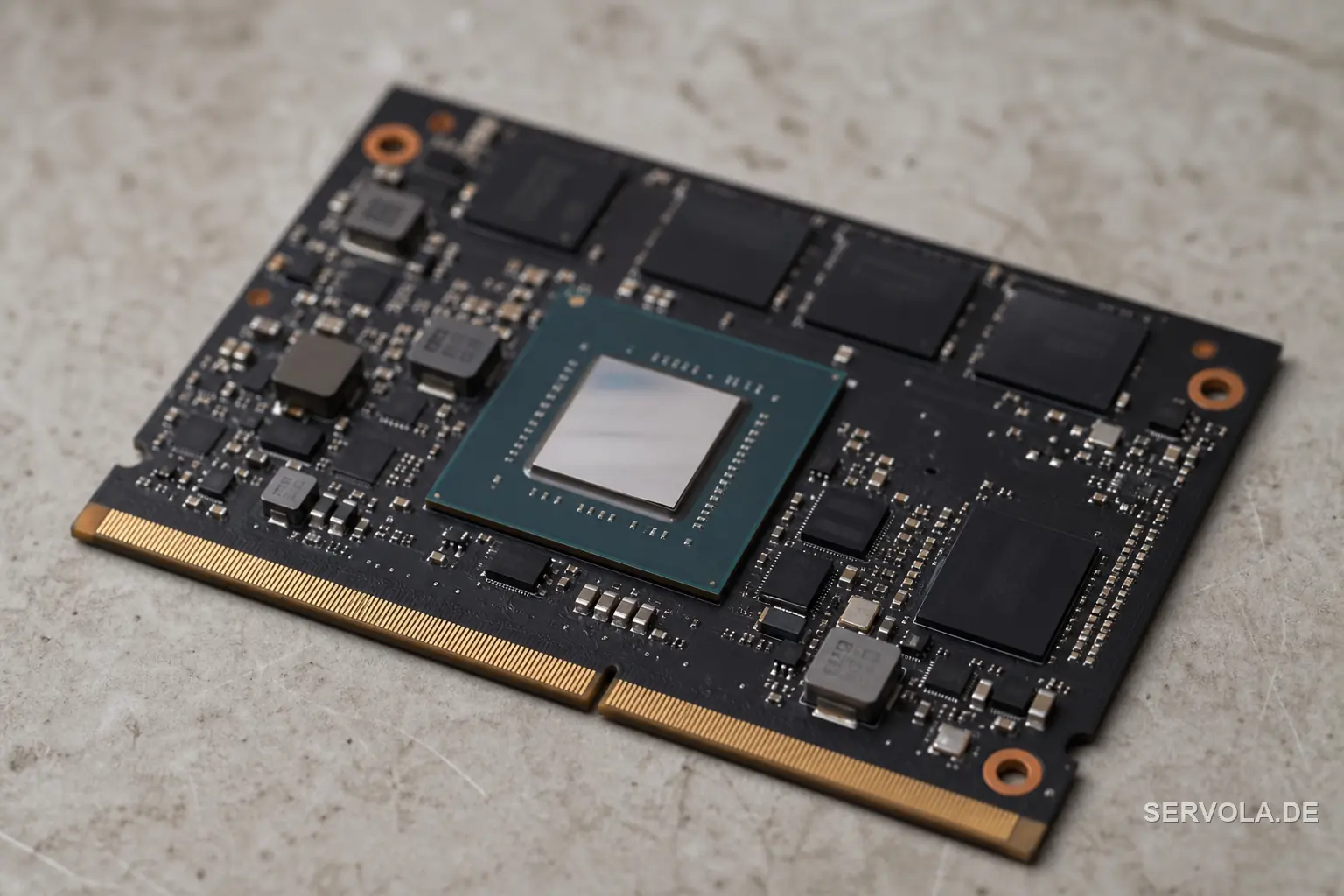
Ukraine's Main Directorate of Intelligence, known as HUR, disclosed on 12 August 2026 that it had recovered an Nvidia Jetson Orin NX computing module from the wreckage of a Russian S-71M Monochrome cruise missile, a weapon carrying a 250 kilogram warhead with a range of roughly 350 to 400 kilometers. HUR said the module, working with an onboard camera, gives the missile machine-vision guidance during the final stage of flight, letting it identify and track a target with a degree of autonomy that older Russian missiles lack.
The Jetson Orin NX is not a weapons component in Nvidia's own catalog. It is a small, off-the-shelf module Nvidia sells for robotics, drones, and industrial machine-vision projects, the same category of hardware an EU factory might use to automate a production line or a delivery robot might use to avoid obstacles.
Nvidia's Own Answer Is The Uncomfortable Part
Nvidia's statement on the discovery is a genuine export-control loophole in the company's own words: the Jetson Orin NX is classified as a consumer product with no export restrictions, unlike Nvidia's data center training GPUs such as the H100 and B200, which are restricted. Nvidia added that used Jetson modules are available through many resale channels and that it cannot track a product after it has been sold, though it says it acts if it identifies a customer violating US export controls.
That answer is accurate and also the whole problem. Western export control regimes, including the EU's, were built to stop advanced training-class chips from reaching Russia, on the assumption that those chips are what a modern weapons program actually needs. A missile does not need a training-class GPU to see a target; it needs exactly the kind of small, cheap, widely resold inference chip that no control list currently restricts.
The EU Just Sanctioned The Middlemen, Not The Chip
The European Union adopted its 21st sanctions package against Russia on 23 July 2026, its largest round of listings in four years, adding 218 new designations including 51 entities tied to Russia's military-industrial complex. Twenty-seven of those entities sit in third countries rather than Russia itself, the exact transshipment routes that let sanctioned goods reach Moscow indirectly.
| Third country | Entities added in the 21st package |
|---|---|
| China (including Hong Kong) | 14 |
| Turkiye | 4 |
| Kyrgyzstan | 3 |
| India | 2 |
| Kazakhstan | 2 |
| United Arab Emirates | 2 |
EU Commissioner Maria Luis Albuquerque said the package was about closing loopholes and strengthening enforcement, and the drone-parts and metal-alloy restrictions in it show Brussels is aware that circumvention runs through named companies in named countries. What the package does not do is add a single AI-relevant edge chip to the restricted list, because the Jetson Orin NX was never on it in the first place. Sanctioning the shell companies that move a chip does not change what that chip is legally allowed to be.
Why This Is Not Only Ukraine's Problem
Ukraine's own tally now runs to 5,816 foreign-made components identified across 202 different Russian weapons systems, a scale that makes this Jetson Orin NX one data point in a much larger pattern rather than an isolated embarrassment for Nvidia. For an EU or UK company that designs, manufactures, or distributes robotics and machine-vision hardware, the practical lesson is not about Nvidia specifically. It is that shipping a device into a market three steps removed from Russia carries real diversion risk even when every component on the invoice is, on paper, entirely uncontrolled.
End-use screening built only around official control lists will keep missing exactly this category of hardware, because the lists were not designed to cover it. Firms selling into distributors in the transshipment hubs the EU itself just sanctioned should treat that geography, not the export classification, as the actual signal worth acting on.
Read next: How 74 Banned AI Servers Reached China Anyway | 74 Of 130 Smuggled AI Servers Reached China