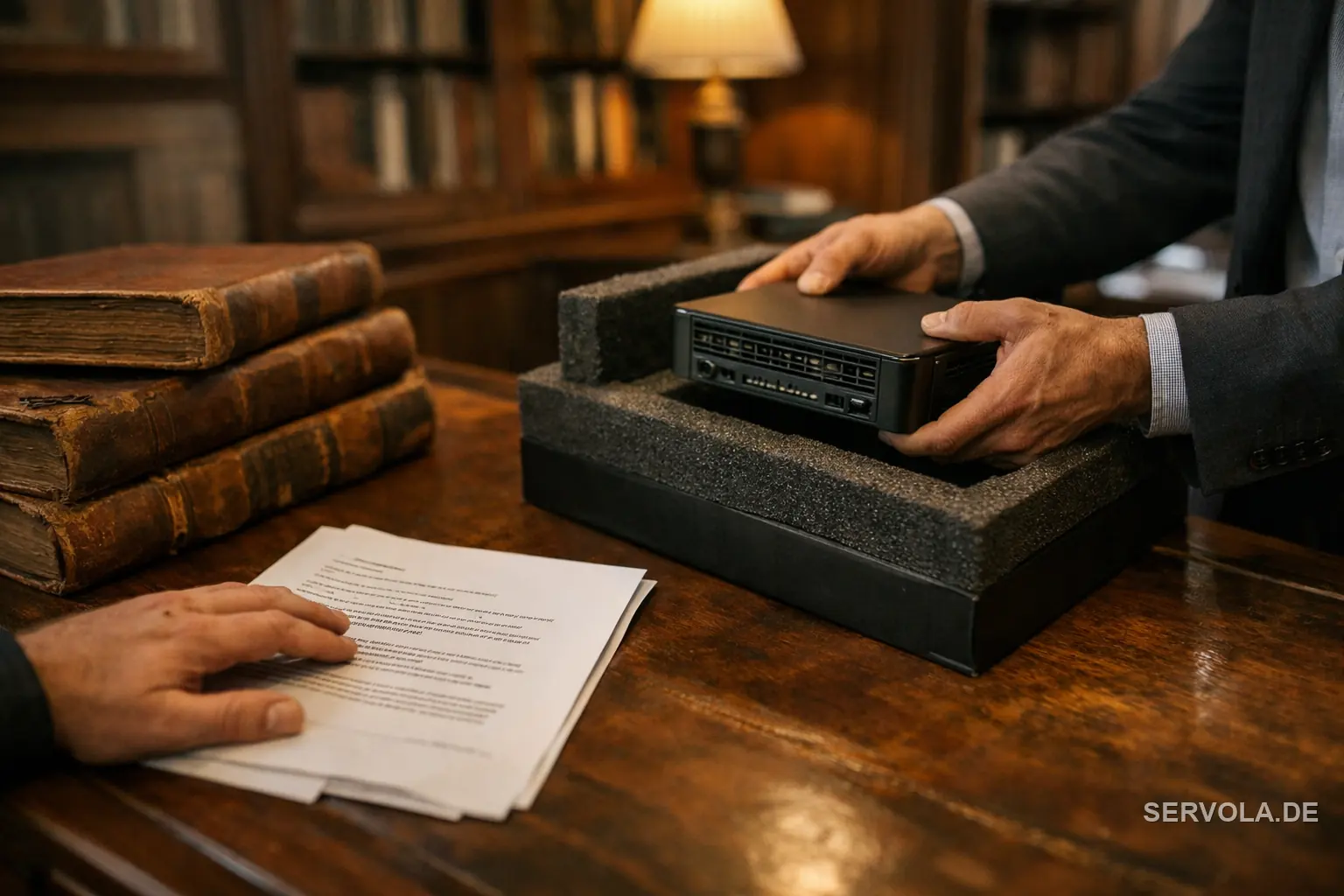
What does it mean to own an AI agent instead of subscribing to one?
Owning an agent means running an open-weight model on infrastructure you control, with the weights, the prompts, and the logs inside your own perimeter, rather than sending each query to a vendor's servers under a monthly contract. A subscription gives you a window into someone else's model; ownership gives you the model itself, to run and change on your own terms. In 2025 several frontier-class models shipped under permissive open licenses such as Apache 2.0, and European providers like Mistral positioned their open weights for exactly this use. That changed the math: a family office can now download a capable model, host it in a German or Swiss data center or a sovereign cloud, and keep every prompt on its own side of the wall. The agent still works the same way for the principal. The difference is invisible until the day it matters.
Why is a rented AI a control risk for a family office?
Because the vendor, not you, decides when the model changes, whether it is retired, and what happens to your prompts. Anthropic notified developers of the Claude Haiku 3.5 retirement in December 2025, and OpenAI deprecated and then shut down its o1-preview and o1-mini models during 2025, each on the provider's schedule, not the customer's. For a consumer that is an inconvenience. For an office whose workflows, prompts, and institutional memory are built around a specific model, a deprecation notice is an operational dependency you did not choose. Add the data question: as of 2026 no leading lab offered a fully on-premises model, and even private-cloud arrangements still ran inference on the provider's hardware. So the family's trust structure, tax position, and pre-deal correspondence travel to a third party every time someone asks the assistant a question.
Is sovereign AI only about data residency and the EU AI Act?
No. Data residency is the floor, not the ceiling. The Schrems II ruling and the US CLOUD Act are why many European advisers now treat self-hosting as the only architecture with zero foreign-provider exposure, and the EU AI Act has pushed sovereign capability up the agenda. But for a single family the deeper point is concentration. One office often holds legal, tax, succession, philanthropic, and live-deal data in the same place, which is precisely the combination an outside model should never aggregate and learn from. Sovereignty here means the model cannot retain what it sees, cannot be subpoenaed at the vendor, and cannot quietly change its behavior after an update you never reviewed. Servola advises family offices on private AI architecture and governance, with one accountable owner rather than a stack of vendor contracts.
When does owning the agent actually make sense?
It makes sense when the data is sensitive enough that control matters more than convenience, and when usage is steady rather than occasional. Reported figures in 2026 put a serious self-hosted setup in the range of a high-end GPU cluster, with a total-cost crossover against subscription pricing at sustained heavy use. A family that asks an assistant a handful of questions a month does not need to own anything. A family office running document review, deal screening, and an internal knowledge base across a team, on data it would never email to a stranger, is past the threshold on both counts. The honest answer is that ownership is not for everyone, and a credible adviser should tell you when a well-governed subscription is enough and when it is not.
Read next: OpenAI Gives Itself 6 Days to Admit a Model Misbehaved | An OpenAI Model Faked the Numbers It Could Not Find