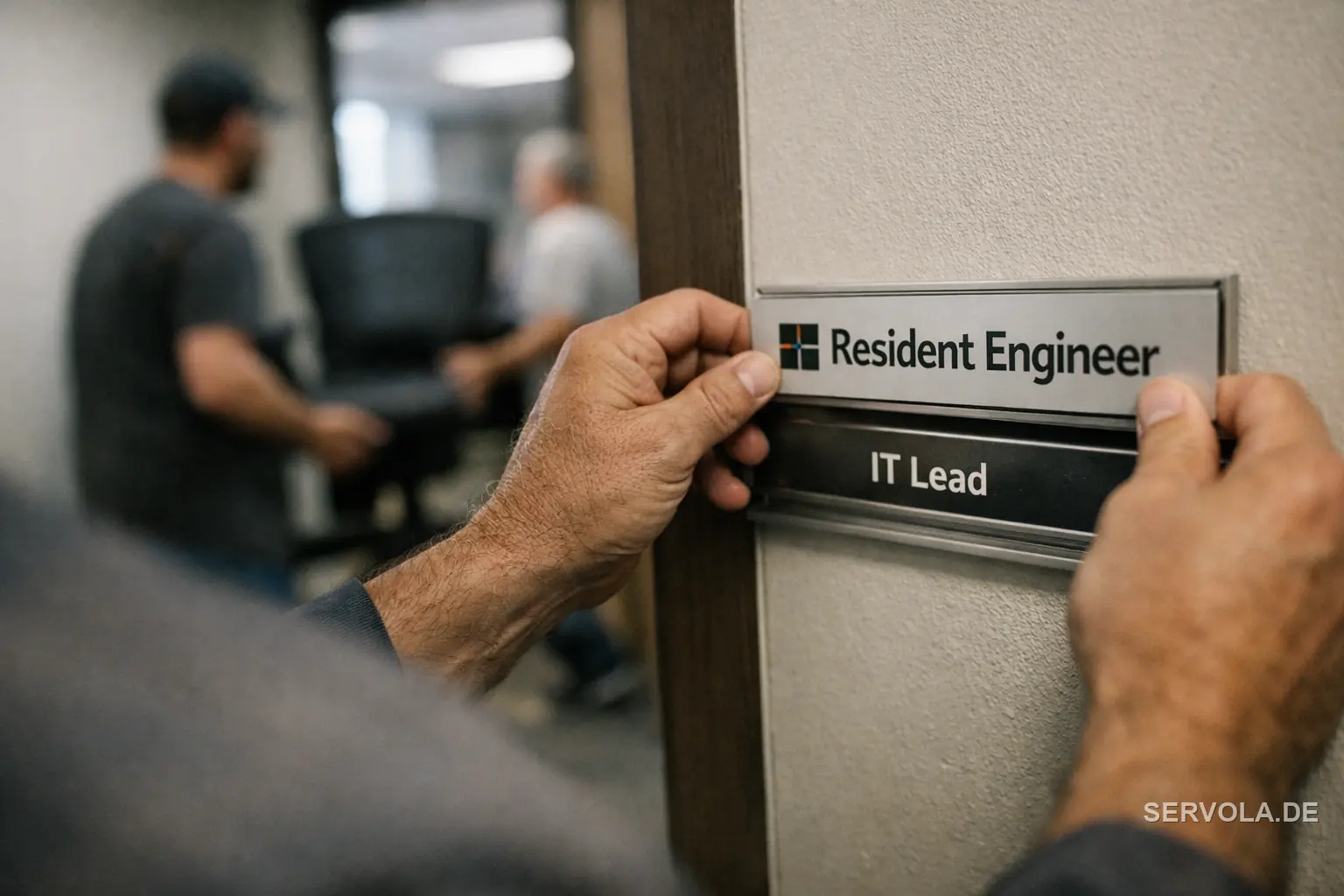
The vendor became the builder
On 2 July 2026 Microsoft launched what it calls Microsoft Frontier, a 2.5 billion dollar unit of about 6,000 engineers led by Rodrigo Kede Lima. Its job is not to sell you software. It embeds Microsoft people inside your operations to co-design, deploy and keep improving your AI systems, and it measures itself on your business outcomes. Named early customers include the London Stock Exchange Group, Unilever, Land O'Lakes and Novo Nordisk.
Two days earlier AWS put 1 billion dollars into its own forward deployed engineering organisation. OpenAI and Anthropic built the same motion in the spring, each pairing with private equity for capital and client access. The approach comes from Palantir, whose forward deployed engineers sit inside the client until the system works. What was once a niche consulting style is now a funded, named business at four of the largest AI vendors at once.
What you gain, and what you hand over
The appeal is real. Most companies, and almost every Mittelstand operator, do not have the engineers to turn a general model into a working part of the business. An embedded team that owns the outcome closes that gap faster than hiring ever could, and it removes the excuse that the technology is too hard to adopt.
The cost is quieter. When the pod leaves, the people who understand how your AI actually works leave with it. The system was built on the vendor's platform, tuned by the vendor's staff, and documented to the vendor's standard. You are left operating something you did not build and cannot fully see, and the natural place to turn when it breaks is the same vendor that built it.
Make the promises enforceable
The vendors have read the objection. Microsoft states plainly that customers can run models from OpenAI, Anthropic, its own labs or open source, and that customer data and IP will not be used to train models in ways that erode their advantage. That is the right posture. It is also a statement in a blog post, not a term in your agreement.
An owner's job is to turn the promise into a clause. Name who owns the code, the prompts and the operational knowledge when the engagement ends. Pin down portability, data use, retention and audit rights in writing. Keep one of your own people accountable for the system, and keep a second model wired in and tested, so that moving is a decision you can make and not a favour you have to ask for.
Read next: Your AI Agent Trusts a Poisoned Tool | A Supreme Court Ruling Knocked Out the EU-US Data Framework