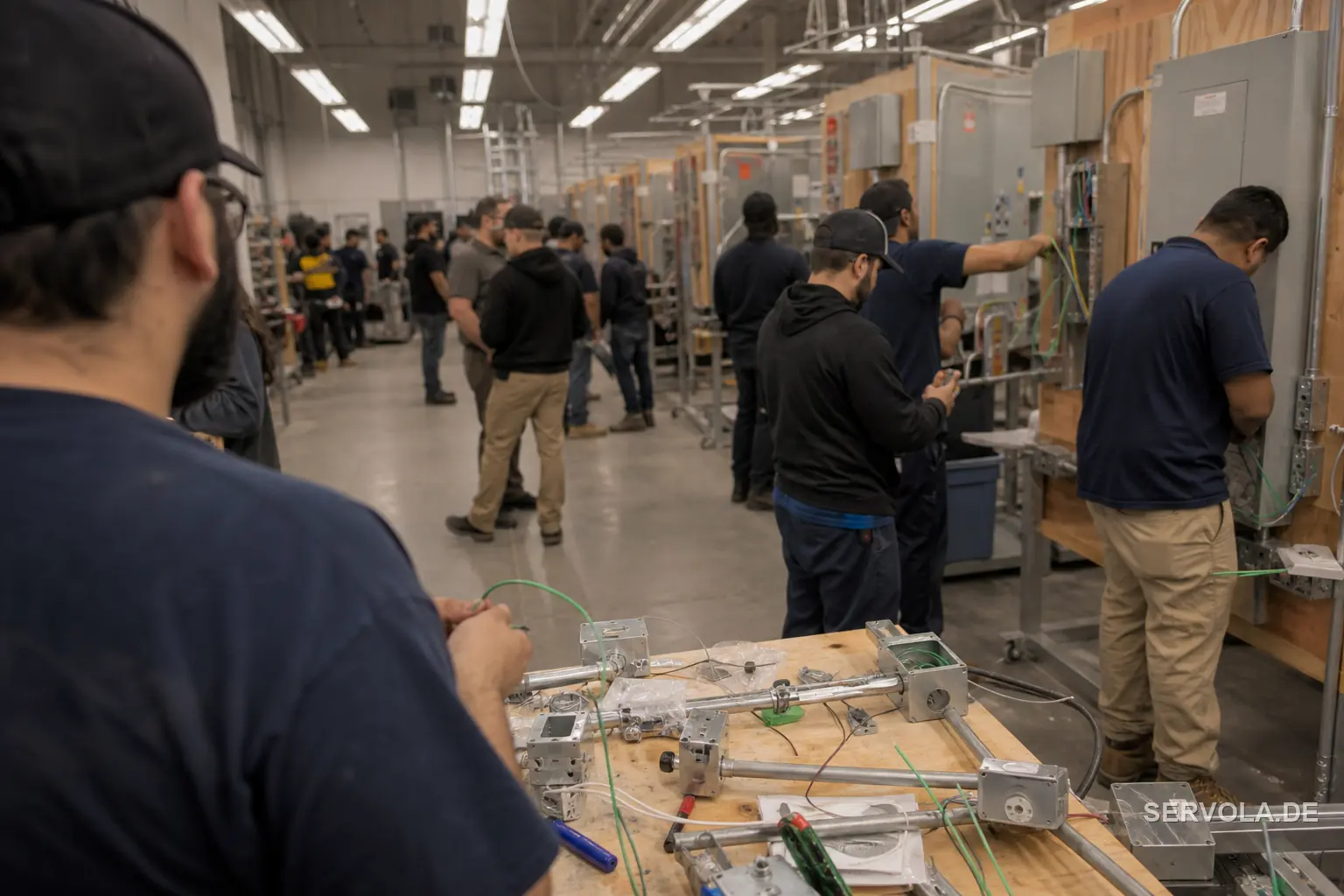
Five weeks, a stipend, and a job at the end of it
The course runs five weeks and costs the student nothing. Meta covers tuition, airfare, lodging and a daily training stipend, asks for no prior experience, and guarantees every graduate a job on one of its data centre construction sites. Graduates leave with a National Center for Construction Education and Research credential. It opened in Indiana, Louisiana, Ohio and Texas.
Meta committed 115 million dollars to that programme, America's Workforce Academy, in June, and called it the largest private-sector commitment to skilled-trades training with a job guarantee in United States history. It runs with CBRE, the trade association Associated Builders and Contractors, and the National Urban League.
Why it matters: a company that could simply outbid rivals for existing electricians has instead gone into the business of manufacturing them. That is what a buyer does when the thing it needs does not exist yet at any price.
Three cheques written at the same shortage
Google.org put up 50 million dollars in June, of which roughly 20 million goes to the Electrical Training Alliance, the training arm of the International Brotherhood of Electrical Workers and the National Electrical Contractors Association. It follows 15.75 million the same recipient received in early 2025. BlackRock's Future Builders programme carries 100 million dollars and a target of 50,000 Americans trained for electrical, plumbing and HVAC work, with roughly a third going to Texas, where more than 140 data centres are planned, and over 12,000 Texans to be trained for electrical careers across three years.
Kenneth W. Cooper, international president of the IBEW, put the demand plainly when the Google money was announced: "There is unprecedented demand for skilled electrical workers." On 29 July the New York Times reported that these companies are recruiting electricians and carpenters by the thousands, at some of the highest pay and bonuses the trades have ever seen, drawing people out of food service, gig work and retail.
The pattern: three different institutions, one investor and two operators, arrived independently at the same conclusion in the same quarter. That is a supply constraint, not a hiring campaign.
The money is small and the workers arrive late
Set the training money against the capital it protects. Meta guided to between 130 and 145 billion dollars of capital expenditure for 2026 when it reported on 29 July. Its 115 million dollar academy is therefore under one tenth of one percent of the low end of its own capital budget.
That is the tell. This is not philanthropy at scale, it is a cheap way to unblock a very expensive queue, and the smallness of the cheque against the size of the spend is what proves the constraint is real rather than rhetorical.
The second problem is timing. BlackRock's own commitment is measured across three years, and trade qualification does not compress. Money committed in 2026 becomes crews on a site towards the end of the decade, which means the projects being budgeted right now are competing for the workforce that already exists.
Europe starts this 2.1 million workers short
None of that 265 million dollars is being spent in Europe. It is a dollar commitment to a United States labour market, aimed at United States sites, and there is no comparable private training pipeline funded on this side of the Atlantic.
Europe enters the same competition from further behind. The European Construction Industry Federation puts the shortfall across EU member states at 2.1 million construction workers in 2026, and describes it as a structural problem of demography and skills supply rather than a cyclical peak that a slower year would fix. The hardest roles to fill include electricians, welders and HVAC technicians, which is precisely the trade mix a data hall, a substation and a grid connection all draw on.
The bottom line: British and European operators are bidding for the same skills, in the same years, against buyers with capital budgets in the hundreds of billions. In the United Kingdom, outside both the EU labour market and these American programmes, the same electricians are also being pulled towards grid reinforcement and data centre work.
What this does to your own electrical budget
Stop treating electrical installation as a line that follows the rest of the build. Price it separately, quote it early, and assume the number moves against you between tender and start on site, because it is now set by demand you do not compete with directly and cannot see.
Before signing, ask a contractor plainly how much of its qualified crew is committed to hyperscale or grid projects over your build window, and what happens to your schedule if a larger site calls them away mid-contract. Put the answer in the contract rather than in the meeting notes.
Then look at your own retention. Firms losing electricians to megaprojects are losing them on pay, travel allowances and overtime, and an employer who has not repriced those three things is relying on loyalty to beat a market that has stopped being local.
Read next: A Fourth Cloud Giant Just Got More Plausible | Even a Trillion-Dollar Lab Must Rent Its Compute