The Ceiling on Daytime Solar Just Broke
Solar met a record 10 percent of global electricity generation in the first half of 2026, up from 8.9 percent in H1 2025 and 5.6 percent in H1 2023, according to a report published on 12 August 2026 by Ember, the London-based energy think tank, written by Kostantsa Rangelova, Ember's Global Electricity Analyst. Solar generation grew roughly seven times faster than total power generation over the same three years, making it the single fastest-moving force in global power systems.
The catch is timing. On the average day in H1 2026, solar met over 25 percent of global electricity demand between 11am and 2pm, then fell to near zero between 8pm and 5am; in more mature solar markets, midday coverage topped 50 percent before the same collapse after sunset. That pattern is now starting to bite the leaders themselves - EU solar installations fell 0.7 percent in 2025, the first annual decline in a decade, as saturated middays made adding more daytime solar less useful.
Four Markets Show What Comes After Daytime Solar
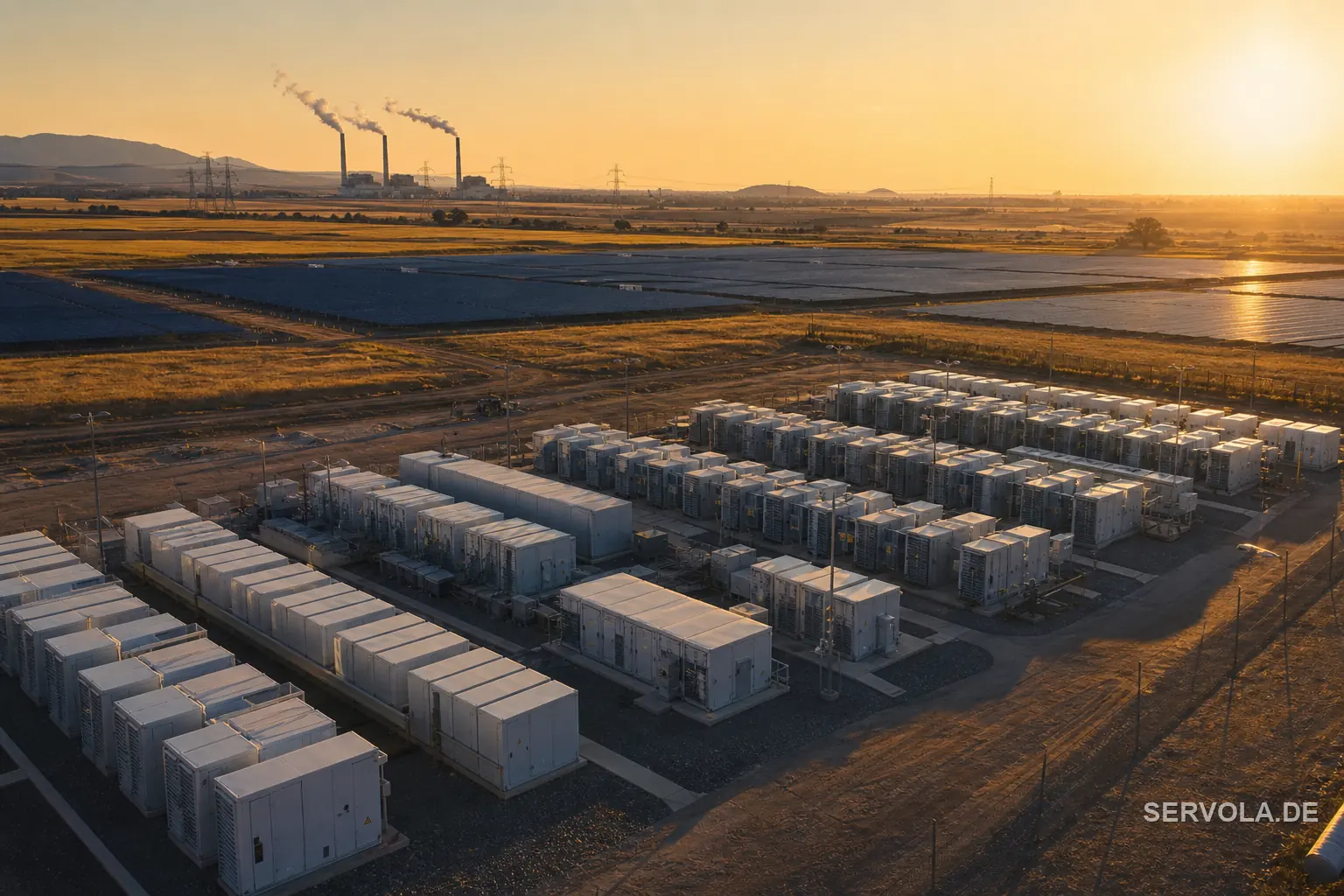
Bulgaria, Chile, Australia and California have each spent roughly three years building enough battery capacity to carry solar generation past sunset, and Ember's report treats them as the leading indicator for every other grid still stuck at the daytime ceiling. Bulgaria and Chile installed enough new battery storage in 2025 to shift over three-quarters of their new daily solar generation into non-sunny hours, followed by Australia at 60 percent; Bulgaria's fleet went from almost nothing in 2023 to 3 GWh in 2025 and then to 8.6 GWh by May 2026.
| Market | Share of new daily solar shifted by 2025 battery additions | Evening (7pm-9pm) demand met by solar plus batteries, H1 2026 |
|---|---|---|
| Bulgaria | 77% | 24% |
| Chile | 76% | Over 10% |
| Australia | 60% | Not reported by market |
| California | Not reported by market | Over 25% (up from 6.8% in H1 2023) |
California shows what that shift looks like once it reaches the grid: on the average day in H1 2026, solar plus batteries met over a quarter of electricity demand during the evening peak of 7pm to 9pm, up from just 6.8 percent in H1 2023. Chile and Bulgaria, where solar contributed almost nothing in the evening three years ago, now cover over 10 percent and nearly a quarter of evening demand respectively - the same hours utilities have historically reserved for gas peaker plants.
The Capacity Plan That Assumes None of This Happened
Most utility capacity plans and industrial power-purchase agreements still price the evening peak as gas territory, on the assumption that solar has nothing left to give after sunset. That assumption was reasonable as recently as 2023, when Chilean and Bulgarian solar was also effectively absent from the evening - it has stopped being reasonable in markets where battery-backed solar has since taken a quarter or more of that same peak.
The economics behind the shift are not exotic. Global average battery installed costs fell 95 percent, from $2,634 per kilowatt-hour in 2010 to $140 per kilowatt-hour in 2025, and the levelized cost of storage was reported around $65 per megawatt-hour for 2025 - cheap enough that 74 percent of batteries installed worldwide in 2025 were already being used for energy shifting, up from 47 percent in 2020. A grid operator or capacity buyer who has not modeled a 30 percent-plus evening-solar-shift scenario is pricing peaker capacity and PPA terms against a grid that no longer exists in the markets moving fastest.
459 Gigawatt-Hours in One Year Is Not a 2030s Problem
Ember expects 459 GWh of new battery capacity worldwide in 2026, fifty percent more than the 307 GWh added in 2025, and enough on its own to shift 34 percent of new daily solar generation into non-sunny hours globally - nearly double the 18 percent shift rate of 2025 and up from just 4 percent in 2021. That is a global average built on a single year's additions, not a projection for the next decade.
The United States added 58 GWh of batteries in 2025, enough to shift about a quarter of new solar generation, with California alone adding more battery capacity than solar capacity every year since 2021. The EU, by contrast, added only 27 GWh in 2025 and shifted just 16 percent of its new solar - below the global average - though EU grid operators' own scenarios expect installed battery capacity to roughly quadruple between 2025 and 2030.
The Real Constraint Is Market Design, Not Battery Chemistry
Ember's 34 percent global shift figure is a theoretical ceiling, not a delivered outcome: not every installed battery is actually used to move solar into the evening, and utilization varies enormously by market. In China, the world's largest battery market, standalone batteries cycled an average of 299 times in 2025 and co-located batteries only 199 times - both below the roughly 350 cycles a year that international best practice can achieve, because regulatory reform has not yet opened enough revenue streams for operators to run batteries harder.
That gap is the opportunity, not a reason to wait. Where market design lets batteries stack revenue across energy arbitrage, ancillary services and capacity payments, utilization rises and the evening-shift numbers in Bulgaria, Chile and California follow; where it does not, batteries sit half-used even as more of them get built. For a grid operator or industrial buyer, the lesson from the leaders is that the physical capacity to displace evening peakers is arriving on a battery-manufacturing timeline, not a market-reform timeline - and the reform is the part still in an operator's own control.
Read next: Australia's Batteries Broke a Record and a Margin | Germany Gives Owners Until 2027 to Dodge New Grid Fees