The round: who put up $1.37 billion, and why JPMorgan is the signal
Hadrian raised $1.37 billion in Series D funding at a $7.87 billion valuation, the company and TechCrunch both confirmed on August 6, 2026. The round was co-led by WCM Investment Management, Washington Harbour Partners, Valor Equity Partners, 137 Ventures and Baillie Gifford, with JPMorgan Chase's Strategic Investment Group anchoring the round through its Security and Resiliency Initiative. Participants included 1789 Capital, Morgan Stanley Wealth Management, funds managed by Apollo, accounts advised by T. Rowe Price, CapitalG, Andreessen Horowitz, Founders Fund, Lux Capital, Altimeter and Construct Capital, alongside existing investors.
The round lands about twelve months after Hadrian's $260 million Series C, led by Founders Fund and Lux Capital, and brings the company's total funding to roughly $2 billion. A jump from a $260 million round to one nearly six times the size, with the valuation climbing to $7.87 billion in that same year, is itself a signal: institutional capital, not just venture funds, now treats automated defense manufacturing as a category worth underwriting at scale, and a bank's own strategic-investment arm anchoring the round is a different kind of validation than a venture fund writing a check.
From parts to submarines: what Hadrian actually builds
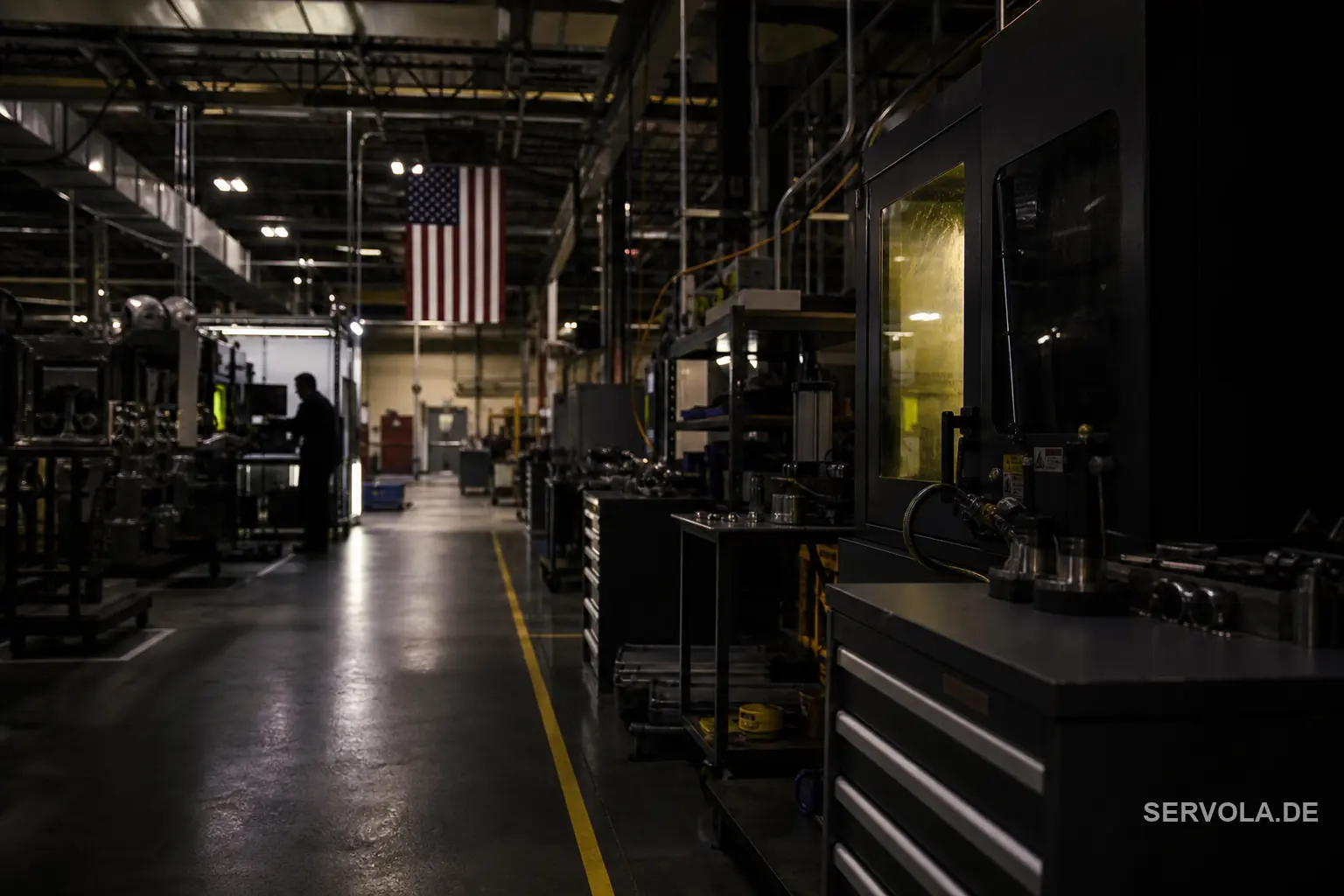
Hadrian builds highly automated factories that combine software, AI and robotics to manufacture precision parts and, increasingly, full mission-critical systems for aerospace and defense customers. Its fourth facility, a $2.4 billion plant in Muscle Shoals, Alabama built as a public-private partnership, opened in March 2026 and produces components for the Navy's Columbia-class and Virginia-class submarine programs, TechCrunch reported.
That is work that has traditionally sat inside prime contractors or their long-established, often family-owned supplier base, not a startup founded five years ago. Hadrian's push into munitions and shipbuilding components, alongside its existing aerospace parts business, means the company is no longer just a faster machine shop, it is becoming a supplier of record for programs the Navy cannot afford to delay.
Factories-as-a-Service: the model behind the valuation
Hadrian calls its approach Factories-as-a-Service: highly automated production lines that combine proprietary software, AI and robotics with process engineering, designed so new capacity can be stood up in months rather than the years a traditional defense manufacturing facility typically takes. The company's footprint now spans just under 3 million square feet across two sites in Torrance, California, plus newer factories in Mesa, Arizona and Muscle Shoals, Alabama, chosen for their existing aerospace, defense and industrial workforces.
The new funding is earmarked for opening additional factories, expanding research and development, and hiring and training the workforce those factories need, with more sites planned within the next year. Speed of capacity, not just precision, is the pitch: Hadrian is betting that the defense industrial base's real bottleneck is how fast new production lines can go live, not whether a design can be manufactured at all.
Chris Power's frontline-of-deterrence framing
Founder and CEO Chris Power tied the raise directly to national strategy rather than company growth metrics: 'Production is now the frontline of deterrence,' he said in the funding announcement. 'America's ability to lead will depend on whether we can build, train, and scale faster.'
That framing is aimed at two audiences at once. To investors, it argues that automated manufacturing capacity is itself a strategic asset, not just a cost center, which supports a valuation built on production speed rather than current revenue. To Washington, it is a pointed argument that the constraint on US deterrence is industrial throughput, not weapons design, aimed squarely at a procurement system that Hadrian and its investors are betting will keep funneling contracts toward whoever can build fastest.
What this means if you sell into, or compete with, the defense supply chain
If you run a defense or aerospace supplier, Hadrian's valuation is now the number your own investors, and your customers' procurement teams, will benchmark you against. A venture-backed factory network that can reportedly stand up new production lines in months, land public-private financing for a $2.4 billion facility, and win submarine-program work within five years of founding changes what fast means in a sector that historically measured new-facility timelines in years, not quarters.
If you buy from the defense supply chain, whether as a prime contractor or a downstream aerospace customer, the practical question is whether your current suppliers can match Hadrian's stated build-out speed, and whether a supplier this well-capitalized becomes a partner worth qualifying now or a competitor worth watching. Either way, a near-$8 billion valuation for a five-year-old parts manufacturer is a repricing event for the entire category, not just a single company's funding round.
Read next: Mistral Raised 3 Billion, Samsung Got a Chip Model | Mistral's Own Chip Suppliers Just Became Its Owners