The round: $700 million-plus at a $5.51 billion valuation, and who is behind it
Lumilens emerged from stealth on August 6, 2026 announcing a Series C round of over $700 million at a $5.51 billion valuation, led by Atreides Management, Bain Capital Ventures, Meritech, Seligman Ventures and Spark Capital. The round, confirmed by the company's own announcement alongside independent reporting from SiliconANGLE, TechFundingNews, FinSMEs and Yahoo Finance, brings the San Jose-based startup's total funding to more than $900 million, an enormous sum for a company that had operated in stealth mode until this announcement.
The additional investor list is unusually broad for a single round: Addition, AICONIC Ventures, Alkeon, Harbourvest, JPMorgan Private Capital, Mayfield, MVP Ventures, Qualcomm Ventures, Peak XV, Redpoint Ventures, Seifdune and others all took part. Qualcomm Ventures' presence is worth flagging specifically, since it is a strategic investor with its own commercial interest in how chips move data, not a purely financial one, and its participation alongside JPMorgan's private-capital arm suggests both chipmakers and institutional capital see optical interconnects as a category worth underwriting now, not later.
What Lumilens actually builds: from near-package optics to co-packaged optics
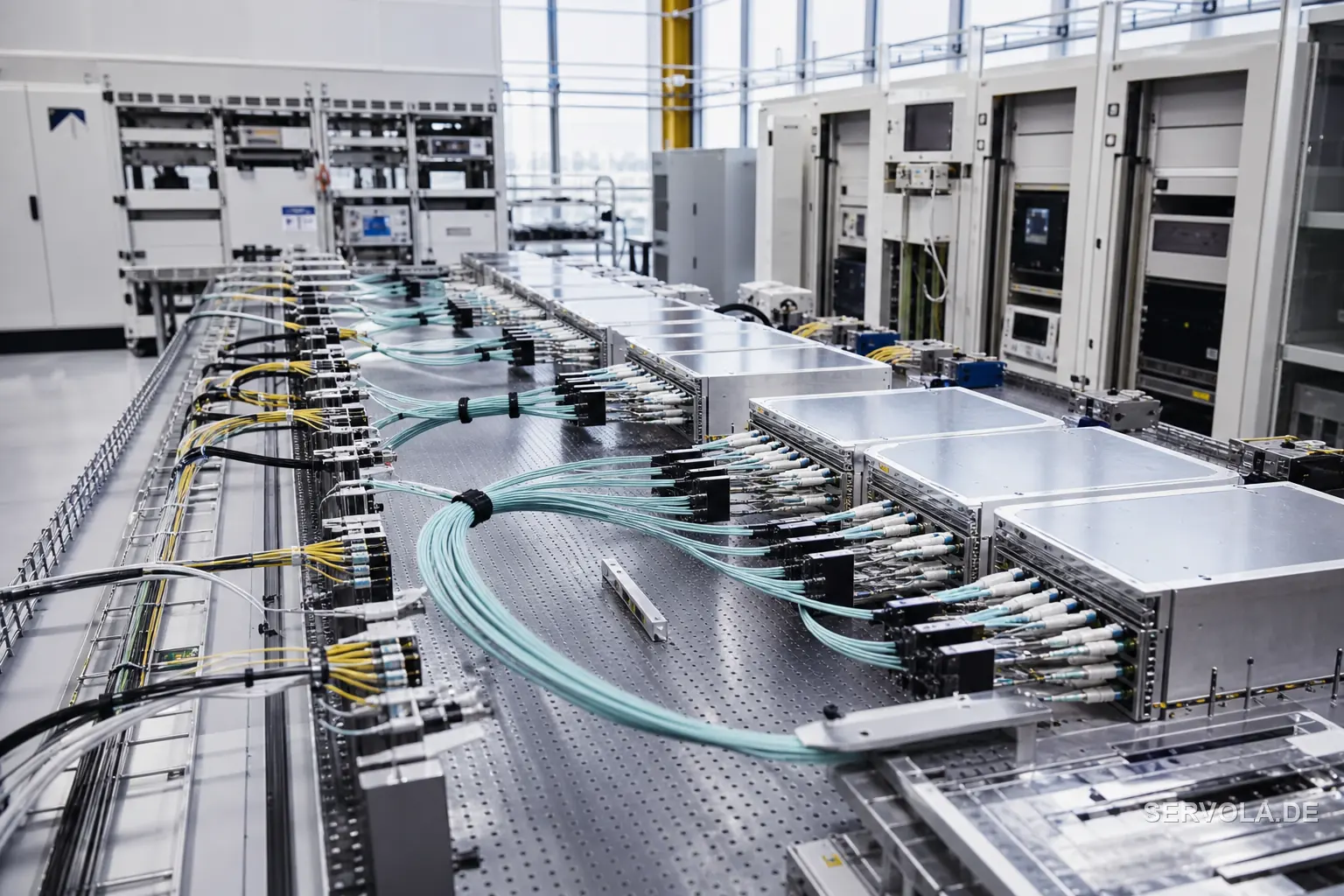
Lumilens makes optical interconnect chips designed to replace copper wiring inside AI data centers with fiber optics across three product tiers: near-package optics, co-packaged optics integrated directly into the GPU package itself, and pluggable optical transceivers running at 800 gigabits per second up to 1.6-plus terabits per second. All three are built on the company's LumiCore architecture, which combines photonic components, mixed-signal integrated circuits and custom interposers into a single design platform, an approach Lumilens says compresses chip development time from years to months rather than the multi-year cycles typical of custom silicon.
The company taped out its first chip in 2024 and now has a second-generation chip ready for commercial deployment in 2026, and it says it is already shipping into production data centers under a multi-billion-dollar customer agreement with one of the four major hyperscalers, which it has not named, on top of having already received billions of dollars in chip orders. Founder and CEO Ankur Singla framed the shift in blunt terms: "The constraint on AI has shifted from how many GPUs you can buy to how many you can connect."
The real chokepoint has moved: from GPU supply to GPU connectivity
The GPU-shortage narrative that dominated 2024 and 2025, waitlists for Nvidia chips, hyperscalers rationing allocation, entire cloud contracts built around who could secure silicon first, is now old news. The chokepoint that matters for anyone budgeting or planning AI infrastructure in 2026 and 2027 is not chip supply, it is the optical interconnect fabric that moves data between GPUs at rack and pod scale. A cluster can have every GPU it needs and still run well below capacity if the fiber connecting those GPUs cannot keep pace, which means extra compute sitting idle for want of connectivity, not chips.
Lumilens going from stealth to a $5.51 billion valuation in a single round, while already locked into a multi-year, multi-billion-dollar agreement with one hyperscaler, is meaningful evidence that this fabric layer is consolidating around a narrow supplier base, the same pattern that played out with HBM memory before it became a recognized bottleneck in its own right. A layer that is invisible to anyone who is not a hyperscaler today has a track record of becoming a visible cost and availability variable in enterprise cloud and AI contracts within a couple of budget cycles.
A vendor-disclosed hyperscaler deal, and why that claim deserves scrutiny
Lumilens says it is already shipping into production data centers under a multi-billion-dollar agreement with one of the four major hyperscalers and has already booked billions of dollars in chip orders, but both figures are disclosed by Lumilens itself, not confirmed by the hyperscaler in question. A contract claim from a still-private, VC-backed supplier is not the same thing as a filed, audited customer commitment, and treating the two as equivalent would be a mistake worth avoiding until the hyperscaler side of the relationship is independently confirmed, whether through a filing, an earnings call disclosure, or its own public statement.
A second nuance worth carrying into any 2026-2027 planning: industry analysts have cautioned that large-scale volume deployment of co-packaged optics specifically, the most technically ambitious tier of Lumilens' roadmap, integrated directly into the GPU package, is still probably two to three years out. Near-package optics and pluggable transceivers can ship at volume sooner, but co-packaged optics reaching production scale on the timeline the excitement around this round implies is not yet established fact.
What this means if you are scoping a 2026-2027 AI infrastructure budget
The practical takeaway is that optical interconnect supply is a new leading indicator worth asking a cloud vendor about directly, the same way GPU generation became a standard question two years ago. An owner renewing a cloud AI contract or scoping a 2027 infrastructure budget should ask which optical interconnect vendor sits behind their provider's cluster fabric, whether that supply is single-sourced, and what happens to effective compute throughput if that fabric cannot scale as fast as GPU procurement does, because none of that shows up in a simple per-GPU price quote.
None of this is visible today to anyone who is not already a hyperscaler negotiating directly with vendors like Lumilens, which is exactly why it is worth surfacing now rather than after it becomes a line item. Treat Lumilens' $5.51 billion valuation and its unnamed hyperscaler agreement as a leading signal that the connectivity layer is consolidating, while treating the specific customer claim with the same caution any vendor-disclosed, unverified figure deserves until confirmed independently.
Read next: Europe's SpaceX Alternative Raises $450 Million | Salesforce Backs the $5B Rival to Its Own AI Tools