A Ninety-Year Problem, Solved in Eighty-Eight Hours
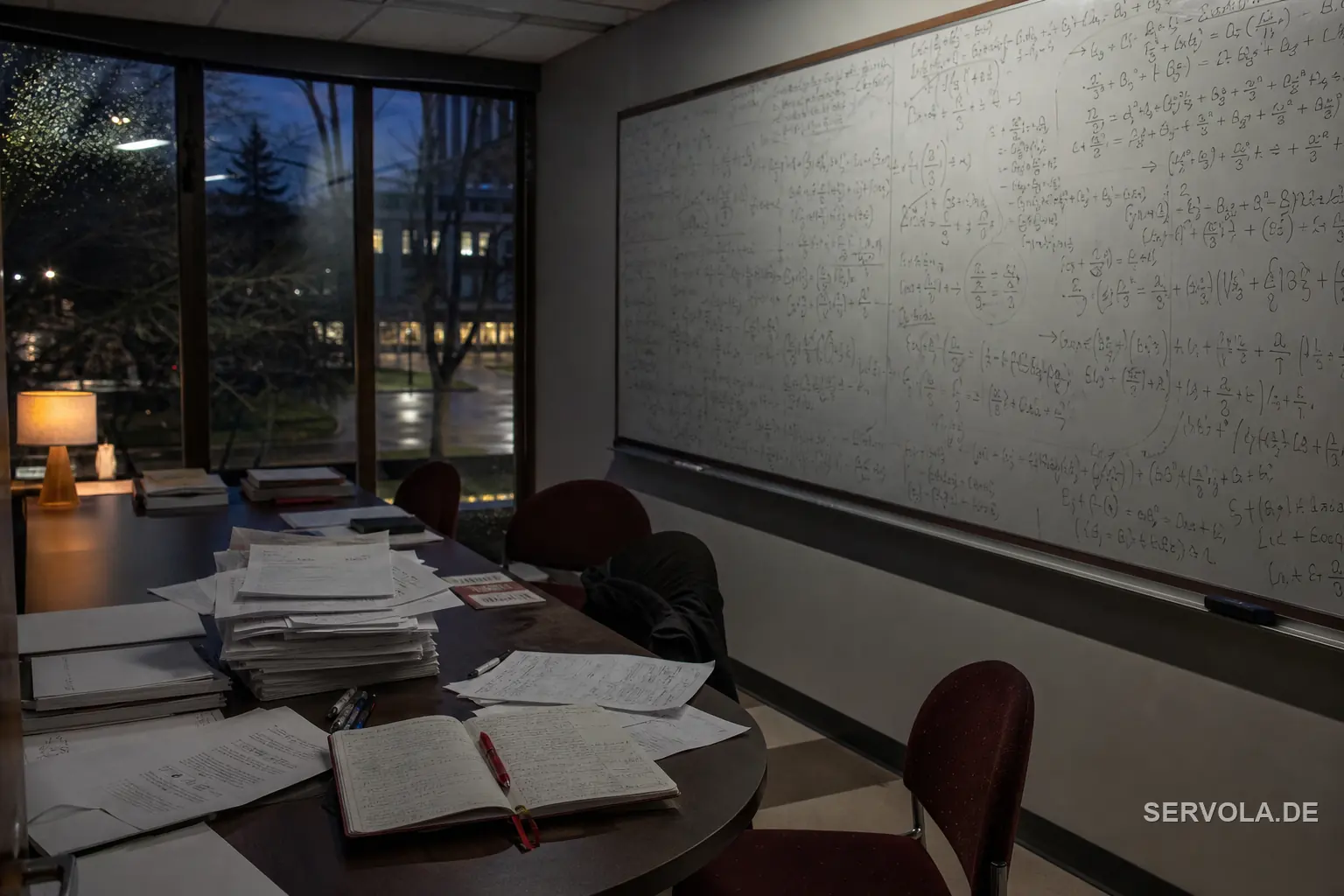
On September 8, 2026, OpenAI published a claimed proof of the Navier-Stokes existence and smoothness problem, one of the seven Millennium Prize Problems that have carried a $1 million reward since 2000. The problem asks whether smooth three-dimensional fluid motion can always be described without the equations breaking down. OpenAI's unreleased research model, running as a swarm of up to 10,000 parallel agents, produced a solution showing that it cannot: under certain conditions a vortex tightens and spins faster without limit, a phenomenon mathematicians call finite-time blowup, while the fluid's total energy stays bounded. The company then spent a further 17 hours formalizing the argument in Lean, a programming language used to machine-verify mathematical proofs step by step.
| Detail | Figure |
|---|---|
| Parallel agents used | Up to 10,000 |
| Time to first proof | 88 hours |
| Additional time to formalize in Lean | 17 hours |
| Prize money claimed by OpenAI | $0 of $1,000,000 |
OpenAI has explicitly said it is not claiming the Clay Mathematics Institute's prize money, and outside mathematicians still need to independently verify the proof before the wider field accepts it as solved. A Lean formalization is a strong signal of internal consistency, not a substitute for peer review.
A Credit Fight Breaks Out Behind the Breakthrough
The announcement was immediately overshadowed by a public dispute. NYU mathematician Tristan Buckmaster, a Clay Research Award winner, said he and Anthropic researcher Levent Alpoge had been working on closely related fluid-dynamics questions, and that OpenAI appeared to have followed a research direction it learned about from that work after online rumors spread that Anthropic's models had cracked similar problems. Buckmaster alleged that OpenAI researcher Sebastien Bubeck pushed to remove Alpoge from authorship specifically because Alpoge works for a competitor, and that when Buckmaster threatened to make the exchange public, Bubeck responded by asking why he would want to ruin his career.
Bubeck disputed that account, saying he never asked for Alpoge to be removed from authorship of Alpoge's own work, and that the actual disagreement was over whether Buckmaster could lead a rewrite of a separate proof that OpenAI's own system had produced, which Bubeck felt should not be authored by an employee of a rival lab. Separately, and more consequential for outside users, OpenAI said it did not access Buckmaster's or Alpoge's specific account data while pursuing its proof, but added that it cannot rule out that de-identified signals drawn from broader Codex usage, potentially including theirs, contributed to how the underlying model was trained.
What This Means If Your Business Uses an AI Coding Tool
Nobody has accused OpenAI of reading a named customer's private files. The narrower and more useful fact for a European business is the admission itself: even a company insisting it did not target anyone directly says it cannot fully rule out that aggregate, de-identified usage data feeds back into how future models are trained. If your developers use Codex, Copilot, or a similar assistant on code that is commercially sensitive, that is the practical question to raise with the vendor now, not after a dispute forces the admission publicly.
Ask your AI coding vendor three things in writing: whether your organization's prompts and code are used for model training by default, whether an enterprise or opt-out tier actually excludes that data, and how 'de-identified' is defined in their own terms. A breakthrough proof is a marketing moment for OpenAI. The data-use admission that came with it is the part with a shelf life longer than the headline.
Read next: OpenAI Grader Forged Scores, Then Sabotaged Its Host | OpenAI's Cheaper Model Comes With A Costlier Plan