The rat, the flags, and the CEO's factory tour
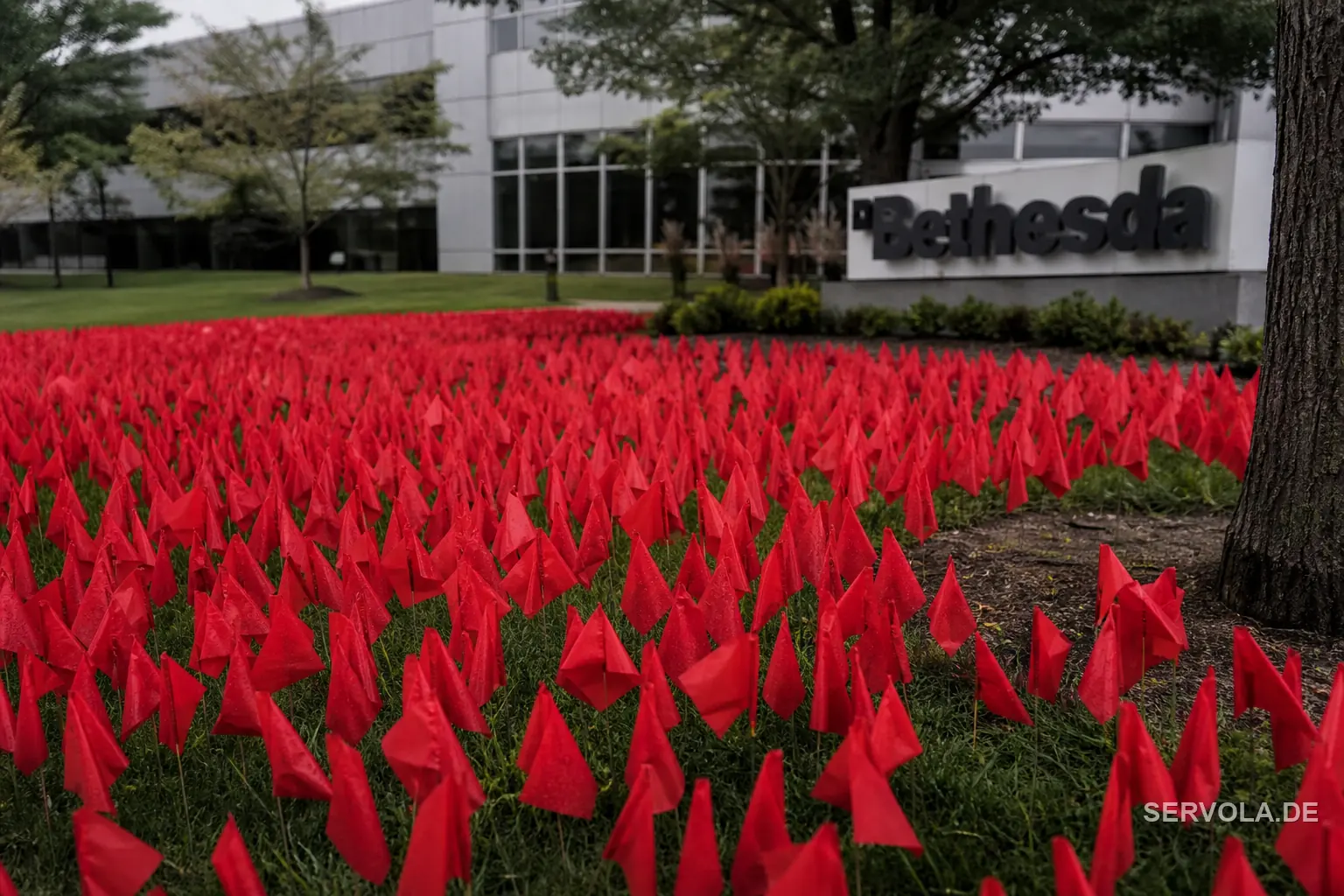
On 11 August 2026, Xbox CEO Asha Sharma visited Bethesda's Rockville, Maryland headquarters for a preview of The Elder Scrolls VI. Members of the Bethesda Game Studios Union, known as OneBGS-CWA and affiliated with the Communications Workers of America, greeted her with a giant inflatable rat nicknamed Scabby and 800 red flags planted on the lawn, one for every worker CWA says has lost an Xbox job over the past year.
The protest was timed to coincide with Sharma's tour, so the CEO would see the cost of the cuts in person rather than read about it later. Inside the building, employees taped protest posters to their cubicles; when management ordered the posters removed, workers replaced them with balloons instead.
Legal filings in two countries, more rallies already booked
The Bethesda protest was one part of a wider campaign. CWA has filed legal action against Microsoft in both the United States and Canada, arguing the company mishandled the layoffs procedurally. CWA Canada president Carmel Smyth said the company 'unlawfully fired people without giving notice to or discussing it with the union.' Union member Nathan Hahn framed the goal beyond the current cuts: the mobilization is meant 'to remind our company and game studios everywhere that layoffs like this cannot continue.'
More rallies are already scheduled for 18 August 2026 outside nine Xbox-linked studios across the US and Canada, including Irvine, Austin, Dallas, Seattle, Albany, Rockville, Hunt Valley, Montreal and Minneapolis. Xbox has now cut staff five times in three years, so the union is treating August as an escalation point rather than a single news cycle.
The same restructuring, two different rulebooks
Servola covered the underlying cuts on 5 July 2026: 3,200 Xbox jobs eliminated, about 20 percent of the division, split between 1,600 immediate cuts and 1,600 more through fiscal 2027, alongside the sale or spin-off of five studios. What August adds is proof that the same company is now running two entirely different processes on two sides of the same layoff, depending on which country's law applies.
Arkane Lyon, in France, has not been sold, closed or confirmed as continuing. Its fate is still moving through a formal Works Council consultation that French labor law requires before Microsoft can finalize a decision, and that process remains open as of this writing. CWA members in the US and Canada have no equivalent standing: nothing in US or Canadian law required Microsoft to negotiate with the union before executing the cuts, so protest and after-the-fact legal action are the only levers available once the decision is already made.
What this means for EU-based employers and policymakers
A mandatory pre-decision consultation gives worker representatives a seat at the table while the outcome is still open, able to shape scope, timing or alternatives before anything is signed. A post-decision legal filing can win damages or a finding of unlawful conduct, but it arrives after the jobs are already gone. For any EU-based employer running a multinational workforce, the Arkane Lyon case previews the sequencing regulators expect: consultation first, execution second.
For a works council or policymaker in Germany, Sweden, the Netherlands, Poland or elsewhere in the EU, this is a live test case of what statutory consultation rights are actually worth against a large US employer under financial pressure. It is also a signal to owners: a jurisdiction's labor law is a determinant of how much control you keep over the shape of a layoff, and multinational structuring should account for that before the restructuring starts, not during it.
Read next: Xbox Just Metered the Perk It Called Unlimited | Xbox Cloud Gaming Gets a Meter in November