The Round: What Open Cosmos Actually Raised
Open Cosmos, an Oxford-based satellite company founded in 2015, raised 300 million euros on September 14, 2026, at a valuation the company has not disclosed. Lightrock led the round, joined by ETF Partners, Institut Catala de Finances, Entrepreneurs First, two international pension funds, and the UK's National Security Strategic Investment Fund, a government-backed vehicle that co-invests in technology it considers strategically important. UK Space Minister Baroness Lloyd called the investment a sign of confidence in Britain's space sector.
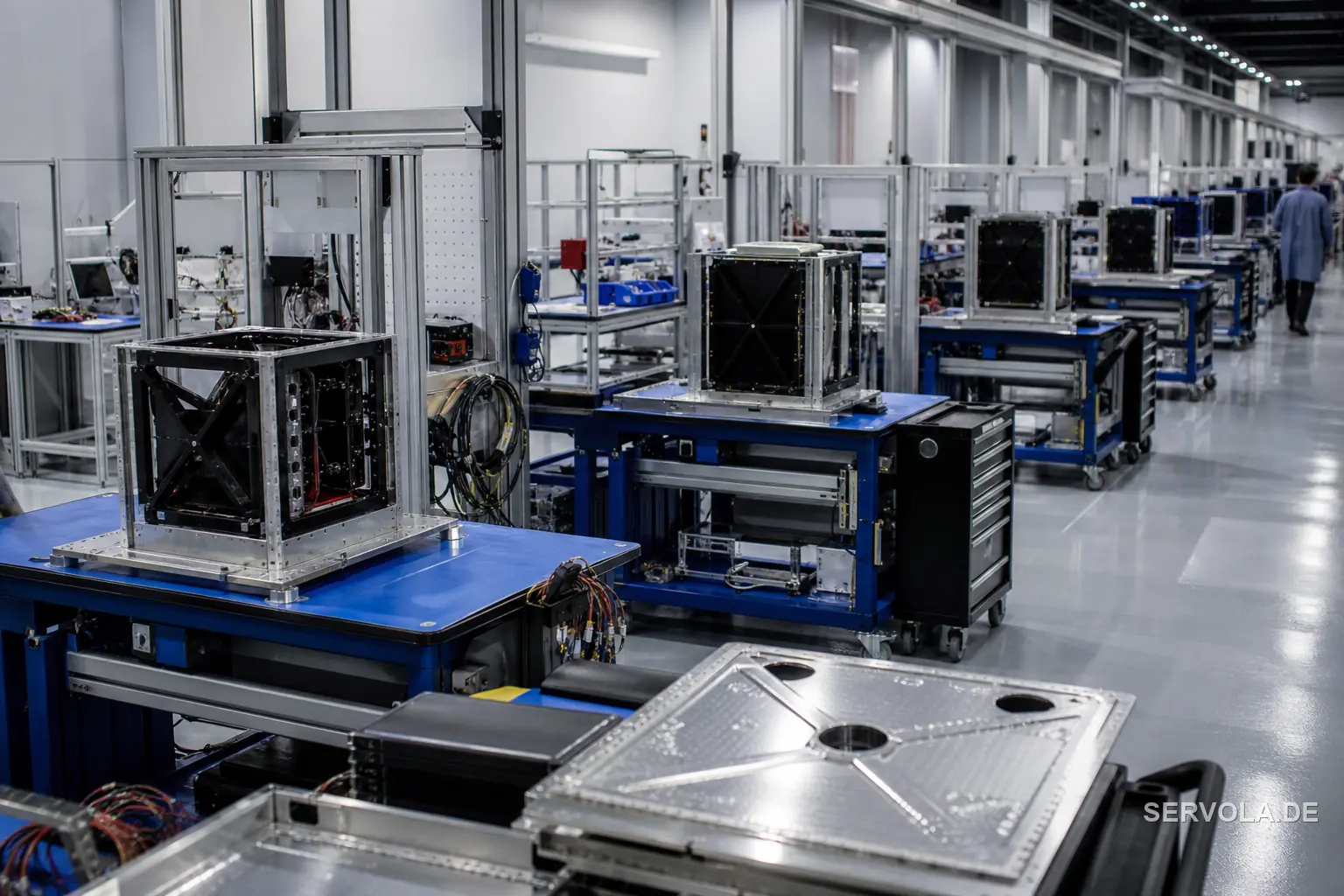
The company employs close to 400 people across four factories in the UK, Spain, Portugal and Greece, where it can now build one satellite a day. It says it has run five consecutive years of profitable growth, an unusual claim in a space industry more often defined by cash-burning bets on future demand, and has signed 370 million dollars in customer contracts since 2022.
Why It Matters: Selling Time on a Satellite, Not the Satellite
Open Cosmos runs three linked services. OpenConstellation is a shared satellite network that Open Cosmos says cuts the time to deliver earth observation intelligence from 48 hours to about 30 minutes, using onboard AI processing instead of waiting for a satellite to pass over a single ground station. DataCosmos turns that raw imagery into usable operational intelligence, and ConnectedCosmos sells secure broadband and IoT connectivity over Ka-band spectrum. A customer does not buy, launch, and operate its own satellite. It buys capacity on a network Open Cosmos already operates.
That is the same shift enterprise software went through when renting server capacity from a cloud provider replaced buying and running your own data center. A government agency that once had to fund, launch, and maintain a single satellite as a multi-year capital project can instead buy measurable access to a shared constellation as a recurring operating cost, with a stated delivery time it can hold the vendor to.
The Sovereignty Angle Behind the Money
The UK government's own strategic investment fund is a co-investor, and Open Cosmos's stated customer base is European governments, space agencies, and large energy and infrastructure companies. The pitch is explicit: European public-sector buyers can get earth observation and secure communications capacity without routing that capability through a satellite operator headquartered outside Europe, at a time when the UK and EU are separately pushing to reduce dependence on foreign-owned digital and space infrastructure.
For a European public-sector or critical-infrastructure buyer, that matters before any national-security argument even enters the picture. Earth observation and secure satellite communications have often been served by one or two non-European incumbents in practice. A funded, profitable, Europe-based alternative changes the procurement math, not just the politics.
What This Means If You Are Evaluating a Space Vendor
The useful question shifts. Instead of asking how many satellites a vendor owns, ask whether it is selling you a satellite, a capital asset you must fund, launch, insure, and eventually replace yourself, or selling you access to a shared network with a stated delivery time you can measure it against. Then check whether its contract backlog is large relative to its headline funding, and whether the business turns a profit or depends on the next funding round to keep running. Open Cosmos discloses figures on all three; not every vendor in this sector will.
Read next: Saudi Sovereign AI Runs on Borrowed Chinese Weights | The EU's New Vulnerability Clock: Just 24 Hours