What Actually Happened This Week
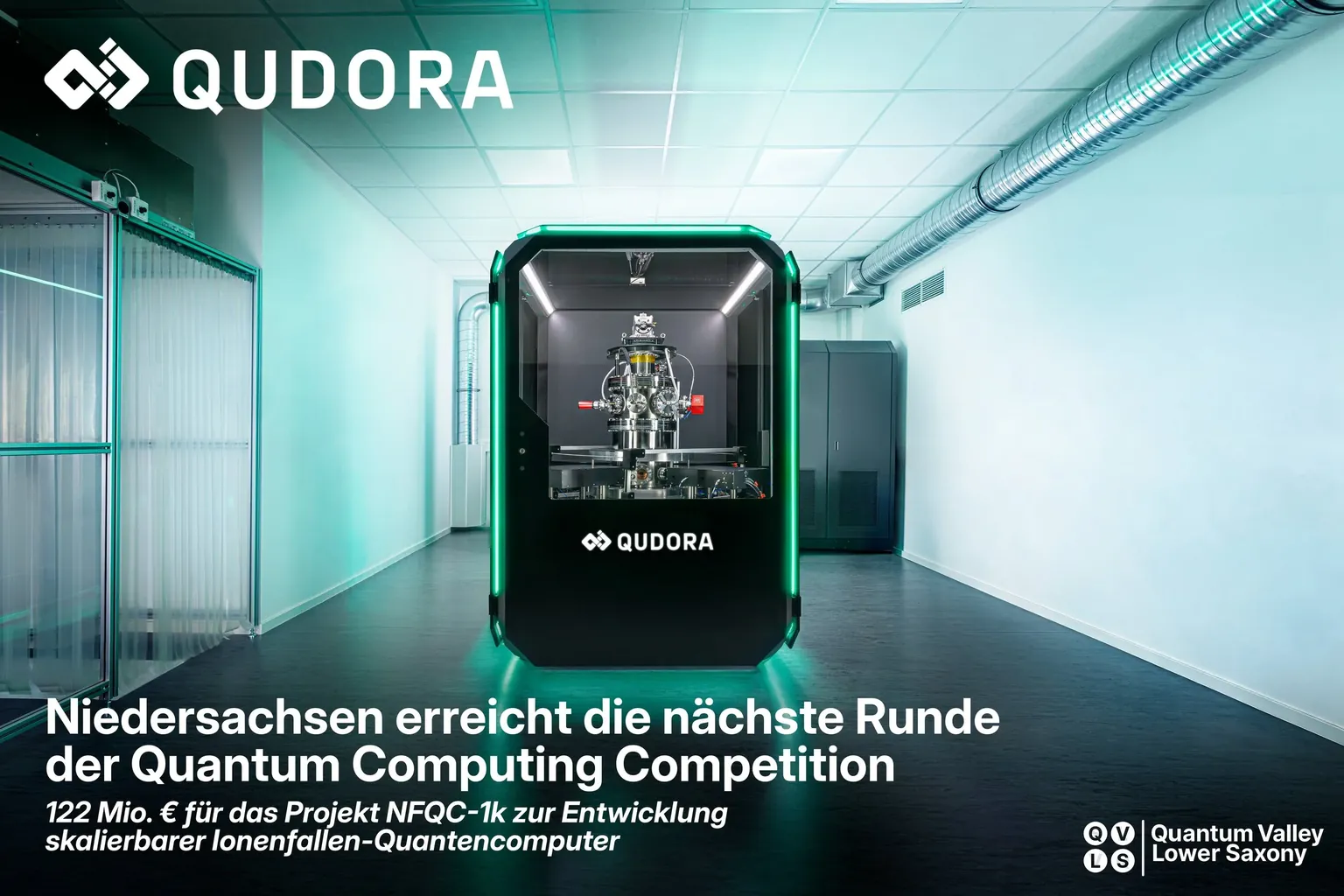
A seven-member consortium led by the Braunschweig startup QUDORA cleared the outline stage of a German government quantum computing competition on September 22 and 23.
QUDORA's own announcement is precise about what that means: following the successful outline phase, the consortium can now submit the full application, after which the partners will move into the concrete implementation phase. That is a two-stage process, and this is the end of stage one. The regional research initiative Quantum Valley Lower Saxony, which represents several of the partners, used the same language: the consortium has been invited to submit a full proposal, not awarded a grant.
Selected Is Doing A Lot Of Work In Those Headlines
Why it matters: a search of coverage from the days after the announcement turns up multiple outlets describing the project as already selected, secured or funded, when the two primary sources describe an invitation to apply for a later decision.
None of that is a small wording slip when the number attached is 122 million euros of public money. A reader relying on the secondary coverage would reasonably conclude Germany just committed nine figures to a named quantum computer. The reader who checks QUDORA's and Quantum Valley Lower Saxony's own language finds a competition still in progress, with a full proposal still to be written, evaluated and judged against other applicants before any funding decision is final. Neither party has said when that decision will come.
What The Money Is Actually For
The project, named NFQC-1k, aims to build a fault-tolerant trapped-ion quantum computer with at least 1,000 individually addressable physical qubits and at least 50 logical qubits, with a logical gate error rate below 0.01 percent.
Alongside the computer itself, the consortium would build a semiconductor pilot line to manufacture the specialized quantum processing units the machine needs, rather than sourcing them from a non-German supplier. The seven partners are QUDORA, TU Braunschweig, Leibniz University Hannover, the national metrology institute PTB, NXP Semiconductors Germany, Forschungszentrum Julich and AQT Germany, the German unit of Austria's Alpine Quantum Technologies. QUDORA chief executive Amado Bautista-Salvador framed the technical bar in a company statement: fault tolerance is not a milestone reached by improving a single qubit, but an architecture in which thousands of resilient qubits can be controlled and operated reliably without the system falling apart as it scales.
The Sovereignty Logic Behind The Bid
NFQC-1k sits inside Germany's High-Tech Agenda Deutschland, a federal strategy that sets a target of at least two fault-tolerant quantum computers at European state-of-the-art level by 2030.
That target only makes sense against a backdrop where the most advanced quantum hardware roadmaps today belong to American and Chinese companies. A German-built machine, using a German-built chip pilot line and a German metrology institute for calibration, is a bet that quantum advantage should not depend on hardware Europe cannot make itself. It is the same logic that drives EU cloud sovereignty spending: the goal is not just access to the capability, but the ability to build and certify it domestically.
What Owners Tracking Sovereign Tech Funding Should Actually Watch
The practical lesson is not about quantum computing specifically. It applies to any headline claiming a government has funded a named piece of sovereign technology.
Two-stage competitions like this one produce a genuinely newsworthy moment at the outline stage, since reaching it is a real filter most applicants do not pass. But it is not the moment money moves, and treating it as one overstates how far along a sovereignty project actually is. Anyone budgeting, partnering or reporting around a public tech-funding announcement should read the funding body's or applicant's own release for the specific verb it uses, selected against invited to apply, awarded against shortlisted, before repeating the headline as fact.
Read next: Germany's New Quantum Computer Needs No Deep Freeze | Berlin's New AI Watchdog Has No Bite Yet