A Feature That Can Call an Ambulance Without You
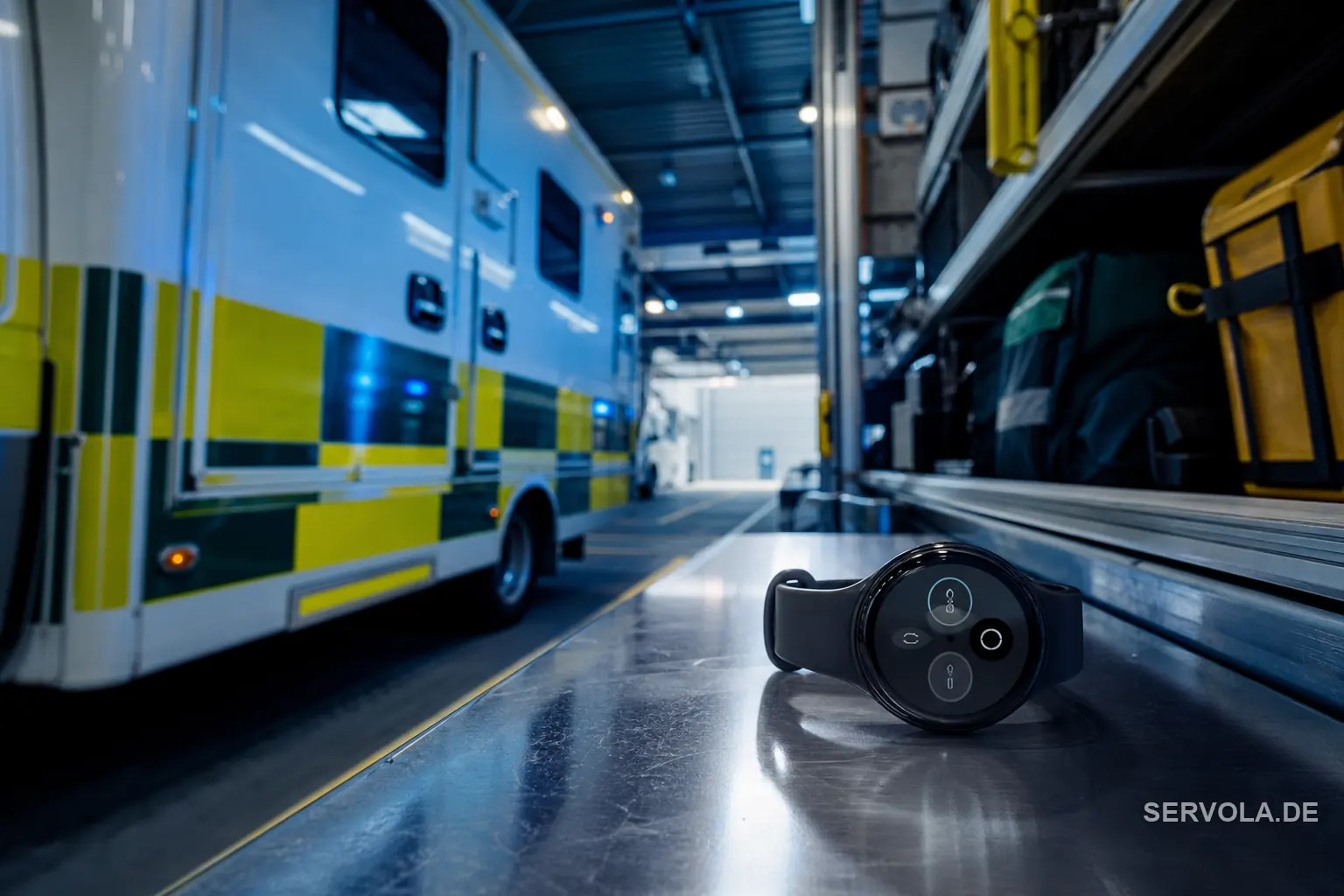
Breathing Emergency Detection, announced by Google on 12 August 2026, is built to catch a specific and rare event: a severe, persistent drop in blood oxygen saturation caused by things like a drug toxicity accident, severe pneumonia or choking. The watch reads three sensor inputs at once, PPG, accelerometer and barometer data, alongside on-device AI, to distinguish a real emergency from ordinary sleep or rest. If it detects the pattern, the watch first vibrates and shows a full-screen alert, then sounds an audible warning with a 30-second countdown. If the wearer does not respond, the watch places an automatic call to emergency services, delivers an automated voice message with the wearer's precise location, and then notifies preset emergency contacts.
Google calls this an industry-first for a wrist-worn device, and says it was built with input from internal medicine doctors, cardiologists, anesthesiologists and emergency medical specialists, then tested in clinical labs and against hundreds of thousands of hours of real-world sensor data. It has real limits by design: it will not fire after 30 minutes of otherwise normal sleep, to avoid confusing sleep apnea with an emergency, and Google says it is not built for people with chronic low-oxygen respiratory conditions or for pregnant users.
Europe First, Not America First
The detail that separates this launch from a routine spec bump is where it lands first. Google's own product post lists the initial countries as Austria, Denmark, France, Germany, Ireland, the Netherlands, Norway, Sweden, Switzerland and the UK, and confirms the feature is CE marked, the EU's conformity standard for products sold across the bloc. In the same breath, Google states plainly that the feature has not been cleared or evaluated by the US Food and Drug Administration.
That is an inversion of the pattern American hardware makers usually follow, where a new feature ships at home first and reaches European users months or years later once local regulators sign off, as happened with earlier blood-oxygen features on rival devices caught up in patent and clearance disputes. Here, the EU's conformity route for this category of software-driven health feature moved faster than the FDA's, and Google chose to put its single most legally exposed feature, one that can place a call to an ambulance on a user's behalf without further confirmation, in front of European and British wrists before American ones.
Blood Pressure and Insulin Resistance, in Monthly Summaries
The watch's other two headline health claims work differently. Blood pressure trend tracking and insulin resistance detection are both powered by what Google calls Health Foundation Models, trained on billions of minutes of sensor data from opted-in users and validated against gold-standard clinical measurements. Neither delivers a live reading; both surface as monthly pattern summaries meant to flag metabolic, respiratory or cardiovascular shifts worth discussing with a doctor, not a number to act on alone.
Google's own disclaimers are unusually direct for a marketing document: the watch is described as not a prescreener for diabetes, not a prescreener for hypertension, and the blood pressure feature is explicitly not intended for pregnant users. A broader line covers all of it: the device is not intended to diagnose, treat, cure or prevent any medical condition. The gap between the industry-first, early-warning language used to sell the watch and the narrow legal language used to describe what it actually claims to do is itself worth noticing.
The Price Ladder Moved Up in Every Currency
Pricing rose across every market Google published. The 41mm Wi-Fi Pixel Watch 5 starts at $399 in the US, GBP 369 in the UK and EUR 419 in Germany; the 45mm Wi-Fi model is $429, GBP 399 and EUR 449. Adding LTE connectivity pushes the entry model to $499, GBP 469 and EUR 519, and the larger LTE model to $529, GBP 499 and EUR 549. That is a step up from the Pixel Watch 4's entry price of GBP 349 and $349.99 a year earlier.
Preorders opened on announcement day, 12 August, with general retail availability from 20 August. A Stephen Curry special edition in the 45mm case, priced at $579, arrives separately on 3 September, positioned above the standard lineup rather than as a like-for-like alternative.
The Pixel Tag Stops Undercutting Apple
Google also used the event to launch Pixel Tag, its answer to Apple's AirTag, priced at $29 for a single unit or $99 for a four-pack in the US, and EUR 34.90 in Europe. That European price sits within a few cents of Apple's own EUR 35 AirTag, rather than below it. The tag uses ultra-wideband for Precision Finding, the same directional-arrow tracking Apple popularized, runs on a replaceable CR2032 coin-cell battery rated to last more than a year, and works through Android's Find Hub network. It will not reach shelves until 11 November 2026, three months after the announcement.
For years, Google and its Android hardware partners have priced accessories below Apple's equivalents to win buyers on value alone. Landing Pixel Tag at near-parity with AirTag instead suggests Google now believes the size of Android's device network and the accuracy of its own UWB tracking can compete with Apple on their own terms, without needing a discount to make the case.
Read next: Google Put Four AI Chips in Orbit, Not a Data Center | Britain Just Said AI Counts as a Search Engine