Ireland Just Became AWS's Only Private Bridge to Europe
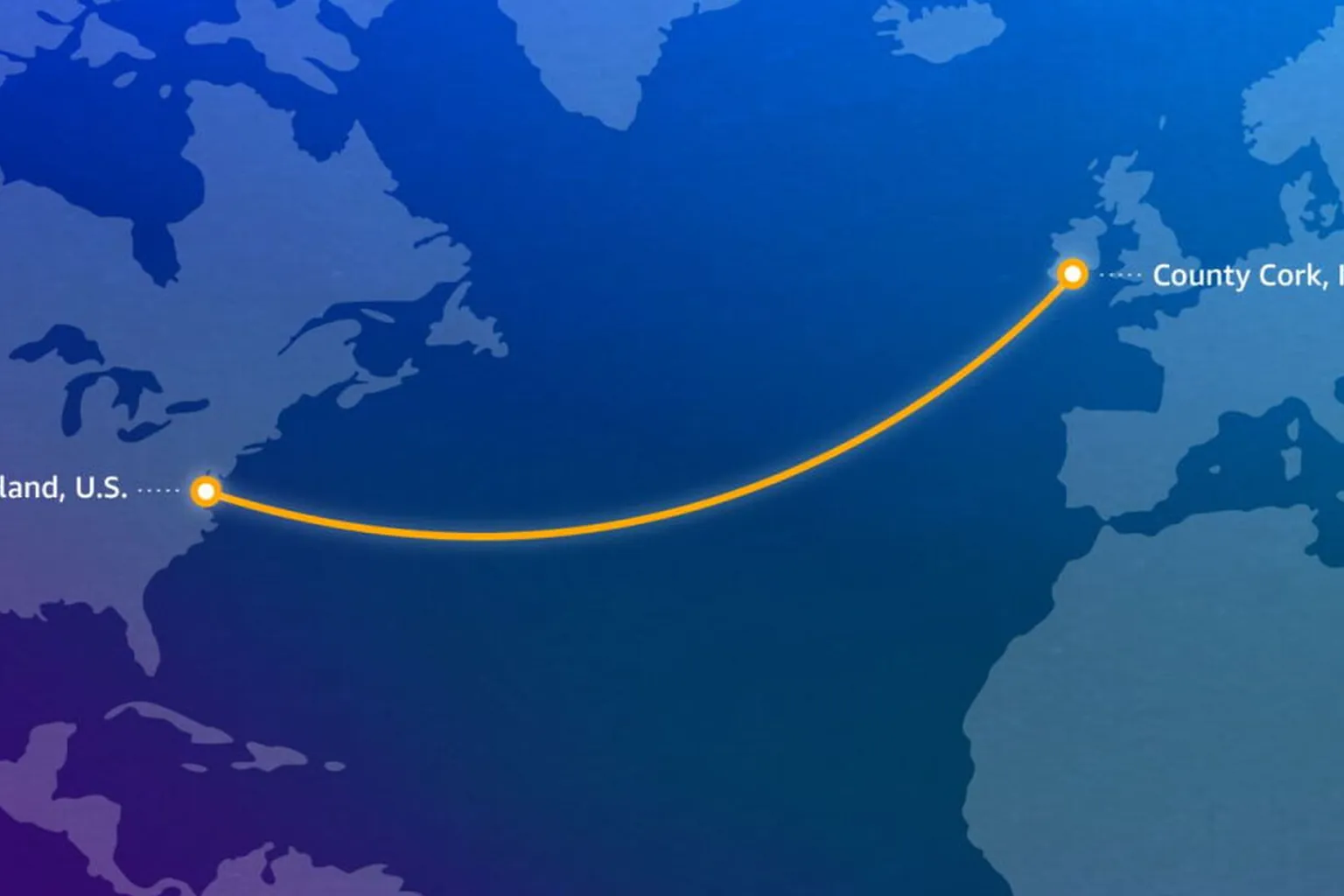
AWS announced Fastnet, its first privately owned transatlantic subsea cable, connecting a new landing station in Maryland to County Cork in Ireland. Irish Taoiseach Micheal Martin called it "a vote of confidence in Ireland's digital future," and Maryland Governor Wes Moore said it was the state's first ever subsea fiber landing. The cable is expected to enter service in 2028.
Until now, AWS has only ever bought capacity on cables owned by consortiums or other carriers, systems like Hawaiki and Marea. Fastnet is different: AWS owns the fiber outright, end to end, which means it also owns the decision about where it lands and how much of it Europe gets.
The Numbers Are a Distraction From the Real Story
AWS says Fastnet will carry more than 320 terabits per second, enough, the company says, to stream 12.5 million HD films at once or move the entire digitized Library of Congress three times every second. Those figures describe theoretical throughput, not what actually determines whether Europe gets more resilient cloud infrastructure out of this.
The part that matters to an operator is the landing point. Most Irish subsea cables come ashore near Dublin or on the west coast around Mayo and Galway. Fastnet lands in County Cork instead, a corridor currently served by only one other system, Exa Express. AWS is framing that as route diversity: a second, geographically separate path into Ireland that keeps traffic flowing if a Dublin-area cable is cut or degraded.
Route Diversity Does Not Fix the Bottleneck AWS Cannot Buy Its Way Out Of
Ireland already carries a disproportionate share of Europe's hyperscale cloud capacity. AWS, Microsoft and Google all run major regions there, drawn by the same low-tax, English-speaking, EU-member combination. That concentration has run into a physical limit that has nothing to do with cables: Ireland's grid operator has restricted new data center grid connections around Dublin for years because the capacity is not there to serve them.
A second private cable landing on a new stretch of Irish coast adds bandwidth resilience, but it does not add a single megawatt to the grid that has to power whatever sits at the other end of that cable. AWS can own the ocean floor route into Ireland twice over and still be waiting on the same national grid operator for the electricity to light up new capacity behind it. The chokepoint European cloud buyers should actually be watching is the one AWS did not announce anything about this week.
What This Means If You Buy Cloud Capacity in Europe
For an enterprise buyer, a second private AWS cable into Ireland is a genuine resilience improvement: one fewer single point of failure between US and EU regions, and one AWS controls directly rather than sharing with other carriers on a consortium cable. It is a reasonable reason to feel slightly better about failover claims in an AWS EU-West service agreement.
It is not a reason to assume EU cloud capacity growth is unconstrained. The grid connection queue around Ireland's main data center corridor is the more binding constraint on how fast new AWS, Microsoft or Google capacity can actually come online there, and Fastnet does nothing to move that queue. Anyone planning multi-year EU cloud capacity commitments should be asking their provider about grid connection timelines in the specific region they are buying into, not just cable route maps.
Servola Journal
We do this for everyone trying to keep up with what technology is doing to our lives. The people who build it, and the people it happens to. The Servola Journal exists so that what we learn belongs to all of them.
Nobody pays us for this. No ads, no paywall, free to everyone. We just believe that understanding what's happening to all of us shouldn't depend on who can afford to pay for it.
If it gave you something today, tell us to keep going. Follow us, leave a like, or write a positive comment. We read every one, and they are what keeps us going.
Read next: Drone Strikes Found the Ceiling on Cloud Backups | Huawei's Nvidia-Rival Chip Arrives Nine Months Early