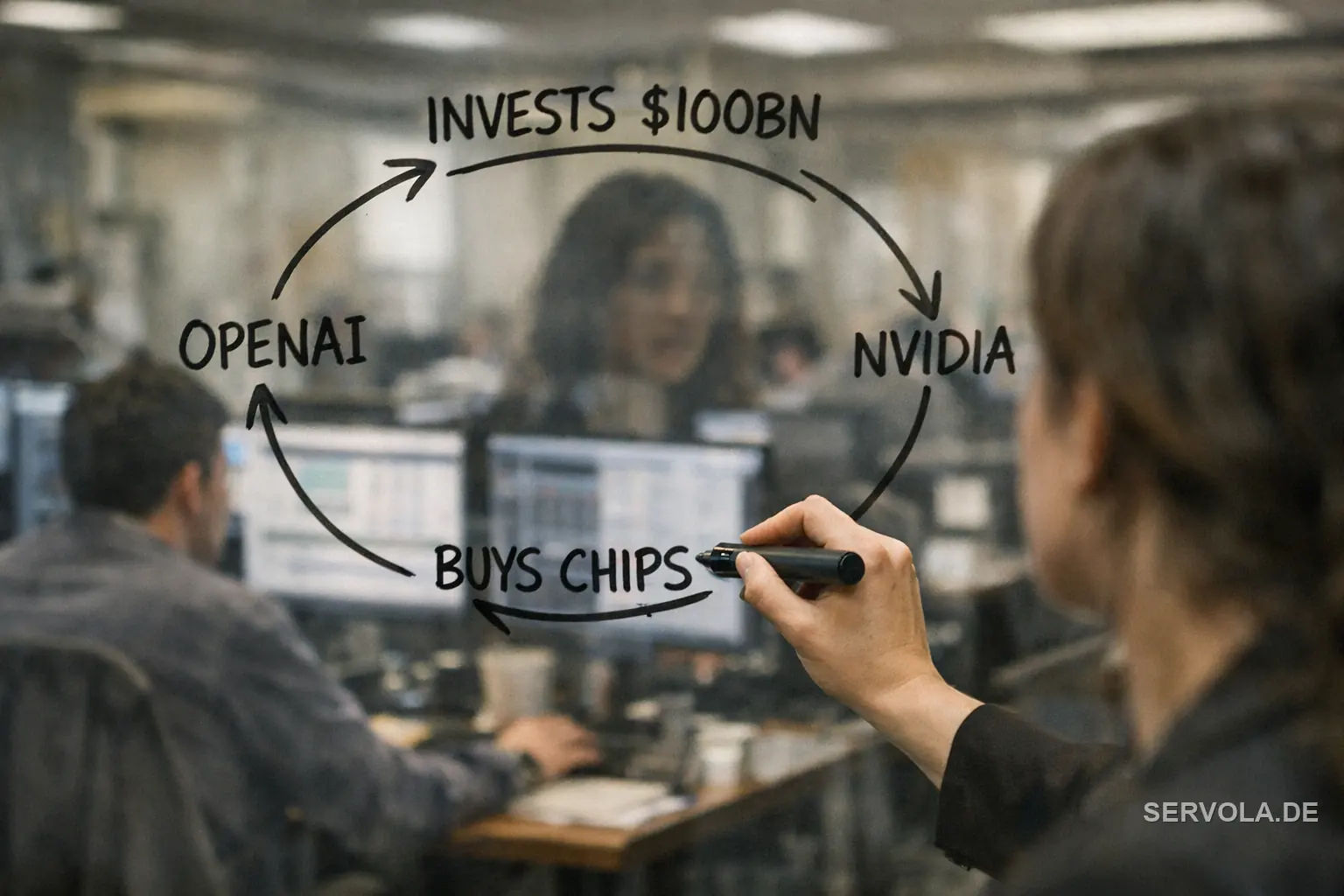
What is circular financing in the AI boom?
Circular financing is when a supplier invests in its own customers, who then spend that money buying the supplier's products. In the AI buildout the loop runs through Nvidia. In September 2025 Nvidia announced an investment of up to 100 billion dollars in OpenAI, tied to OpenAI deploying at least 10 gigawatts of Nvidia-based data center capacity. The cash goes out as an investment and comes back as a chip order. Reporting through 2025 and into 2026 describes the same pattern across OpenAI, Anthropic, Microsoft, Oracle, AMD and CoreWeave, with money, chips and cloud credits rotating among the same handful of companies.
Why does this matter more than a normal vendor deal?
Because it makes demand look stronger than independent demand would, and a vendor that funds its own buyers can keep that signal running long after genuine end-use would have cooled. Stacy Rasgon, a senior semiconductor analyst at Bernstein, wrote after the OpenAI deal that it would clearly fuel circular concerns, with the size of the investment dwarfing the others before it. The mechanics are simple: revenue rises, the investee's valuation rises, the supplier's valuation rises on that revenue, and each leg cites the others as proof. When the investor and the customer are effectively the same balance sheet, the financial statements of both get harder to read from the outside.
Does a circular loop mean the AI boom is fake?
No, and that is the trap. The compute demand is real and the technology is real; circular financing does not require the underlying business to be fake, only that some of the demand is manufactured by the same balance sheet that books the sale. The honest position is that you cannot tell the proportions from the outside. The loop diverges from reality only once the funding slows, and by then the concentration is already built into supply chains, valuations and credit. Treating it as a single switch, fully real or fully hollow, is the mistake.
What should an owner or family office actually do?
Map your exposure to the single dollar that keeps recycling. First, look through the labels: a diversified-looking tech allocation, a vendor's growth story and a private credit position can all terminate at the same Nvidia-funded loop, so measure true concentration, not nominal diversification. Second, price the funding-slows scenario explicitly rather than the headline-growth one, because that is the case the circular structure hides. Third, separate the operating decision from the investment decision. Adopting AI in your business and underwriting the companies that sell it are different bets, and conflating them is how the recycled dollar reaches your books twice.
Read next: A King Asked AI's Leaders for Reassurance, Not Rules | Snap's Enterprise Glasses Answer to Four Vendors