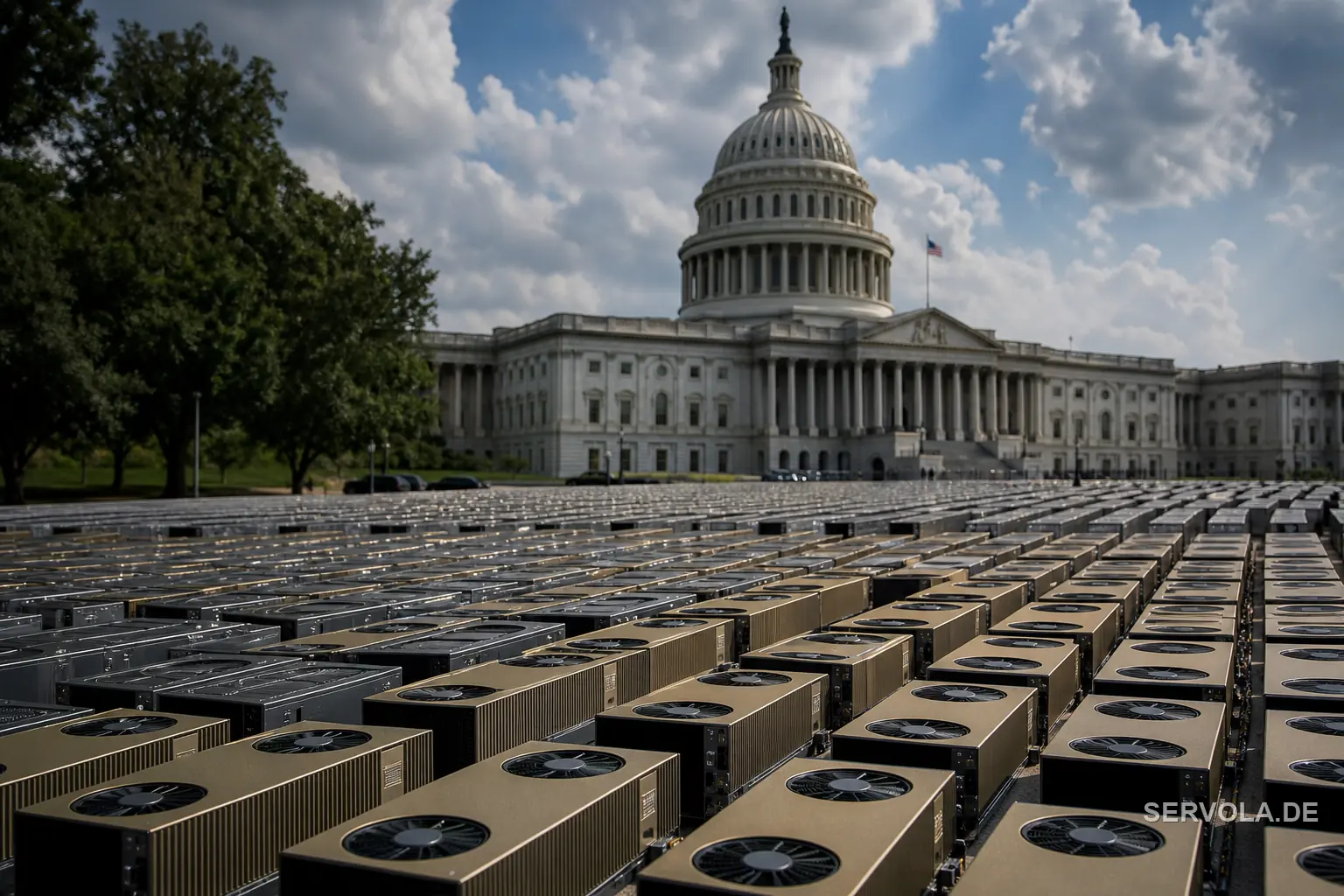
A License, Not a Merger, and No Filing Either
The US Department of Justice has sent Nvidia a formal information request over the December 2025 deal in which the company paid roughly 20 billion dollars for a non-exclusive license to Groq's inference chip technology and hired away founder and CEO Jonathan Ross, president Sunny Madra, and much of the senior engineering team. Groq continued operating on paper as an independent company. Investigators are examining whether that structure was chosen specifically to avoid the premerger notification a formal acquisition of Groq would have triggered under the Hart-Scott-Rodino Act.
The inquiry opened quietly within weeks of the deal's announcement and stayed low-profile for most of 2026. It escalated to a formal civil demand for documents and testimony this month, the clearest sign yet that the DOJ sees a real question to answer rather than a routine file. Nvidia has called the arrangement, in the company's own words, a prime example of the American system working as designed to promote innovation, reward entrepreneurs, and benefit consumers. Senators Elizabeth Warren and Richard Blumenthal had already pressed the department for an answer on the same deal back in March.
This Is Nvidia's Third Deal Built The Same Way
Groq's own numbers show what a licensing-and-hiring deal does to the company left behind. It raised 350 million dollars in August 2026 at a 3.5 billion dollar valuation, half of the 6.9 billion dollars it commanded a year earlier, with Nvidia itself among the investors who priced the new round. The team that built Groq's roadmap sits inside Nvidia now; the company that carries the Groq name has repositioned itself as an AI inference operator, competing on running other firms' models rather than selling the chips it used to design.
Nvidia has since repeated the structure at least twice more. In August 2026 it paid roughly 6 billion dollars to license coding technology from Poolside and extended job offers to 109 of its engineers, again without buying the company. It is also in talks with Rebellions, a South Korean inference chipmaker, on terms that would sit entirely outside US merger jurisdiction regardless of how they are structured. Each deal on its own reads as two ordinary business decisions: a technology license, and a hiring wave. Three in a row reads as a playbook.
Brussels Built Tools For Purchases, Not Hires
The European Commission has spent the past two years building new mechanisms specifically to catch acquisitions that slip under standard turnover thresholds, aimed at exactly the kind of quiet, high-value deal this case describes. None of them were built around a transaction that never becomes a purchase in the first place. A technology license followed by voluntary hiring does not obviously fall into the concentration categories those referral tools were written to identify, which means a European AI challenger absorbed the same way Groq was would likely clear Brussels with no filing either, on either side of the Atlantic.
That gap matters most to the challenger, not the acquirer. A startup that licenses its core technology to a much larger customer and then loses its founding team to that same customer's payroll has, in every practical sense, been acquired. It keeps a cap table, an office, and a name, and its remaining commercial relationships now run through an owner nobody voted to approve. Any European AI company weighing a strategic partnership with a chipmaker or hyperscaler should read its own term sheet with that outcome specifically in mind, because neither Washington nor Brussels has yet built a rule that reliably catches it before it happens.
Read next: Google Just Helped Fund the Lock-In UALink Was Built to Beat | $36 Billion Chip Financing Program Partly Frozen