Three Letters of Intent, Not Three Investors
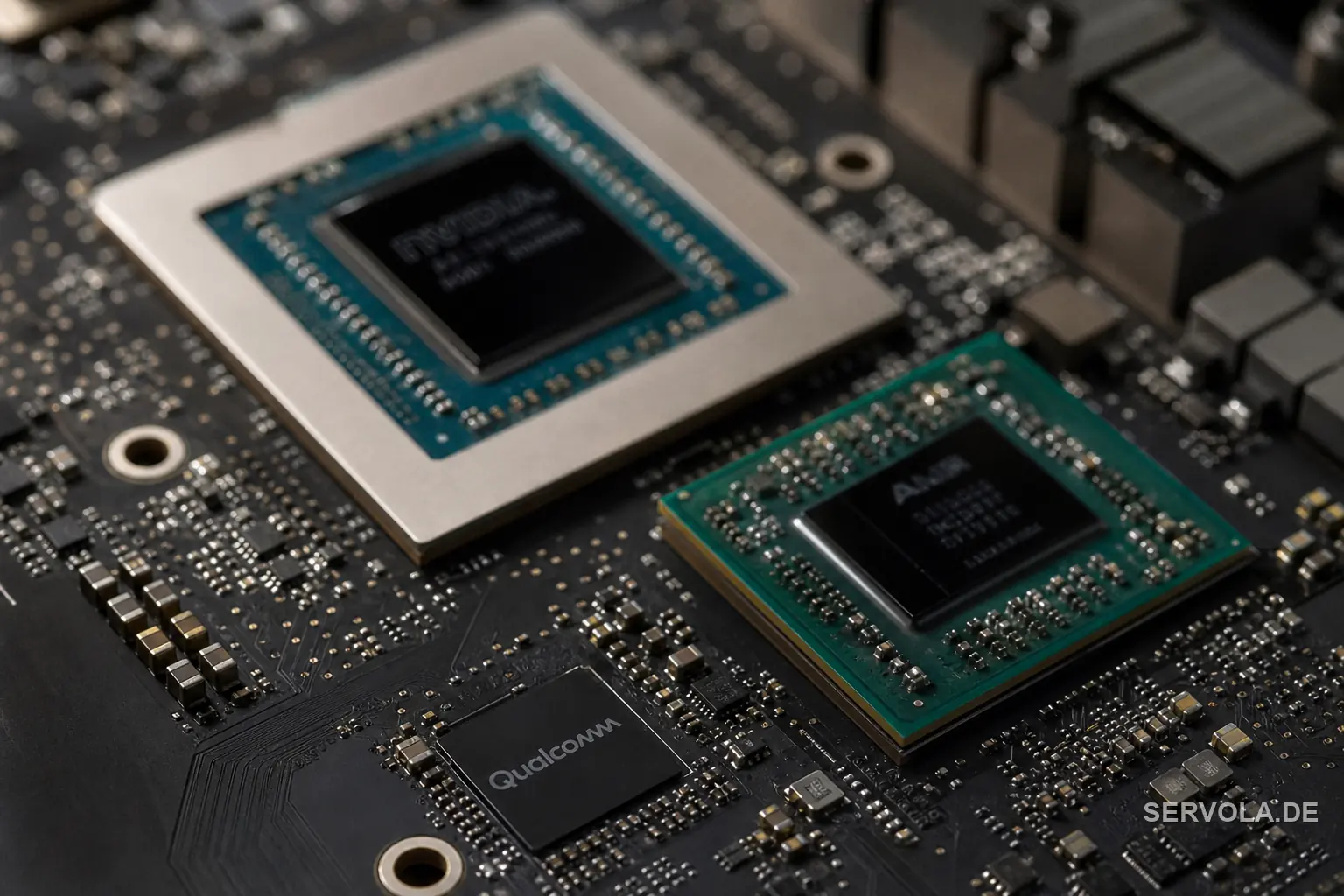
On 30 July 2026 the European Commission opened its tender for up to seven AI Gigafactories, and alongside the call it disclosed that it had signed letters of intent with Nvidia, AMD, and Qualcomm as launch hardware partners. Euronews, which first reported the detail, said the agreements follow the EU-US trade deal and are meant to give the winning consortia reliable access to advanced processors. None of the three letters gives Brussels a shareholding, a board seat, or a vote in how any of the three companies allocate chips between customers.
That distinction matters more than it sounds. A gigafactory is a building: land, power connections, cooling, racks, and a security perimeter, plus the public subsidy that helps pay for it. The processors that make it an AI gigafactory rather than a warehouse still come from firms headquartered in the United States, selling into a global order book Brussels does not control. The Commission's own funding structure reflects this honestly: the tender pays for infrastructure, not for a domestic chip industry to rival Nvidia.
What Up to 30 Billion Euro Actually Covers
The published breakdown is up to 10 billion euro of European Union and national public money against at least 20 billion euro of private capital, unlocking a program the Commission values at more than 30 billion euro in total. Roughly two-thirds of that sum has to come from investors and industry, not from taxpayers.
The public side is thinner than the headline number suggests. Euronews reported that Brussels can commit only about 1 billion euro directly right now; the rest of the EU-level contribution is expected to come from the next Multiannual Financial Framework, the EU's seven-year budget that member states still have to negotiate. A program this size is being announced before all of its own public financing is locked in.
Eighteen Signed a Procurement Pact, Ten Want a Site, One Wants to Go Alone
Eighteen member states, Croatia, Czechia, Denmark, Estonia, Finland, France, Germany, Greece, Hungary, Ireland, Italy, Latvia, Lithuania, Poland, Portugal, Slovakia, Spain, and Sweden, have signed onto the joint-procurement arrangement that sits alongside the Gigafactories call, according to the Commission. That is a mechanism for buying compute capacity together, not a guarantee that a site lands on any of their territory.
Euronews separately reported that ten of those states, Germany, Italy, France, Poland, Czechia, Denmark, Finland, Greece, Portugal, and Spain, have specifically expressed interest in hosting one of the seven facilities, and that around 76 preliminary consortia had already approached the Commission before the formal call opened. France, present in both groups, is reportedly leaning toward bidding on its own rather than inside a multi-country consortium, a sign that at least one large member state does not expect the shared-infrastructure model to serve it better than going it alone.
The Sovereignty the EU Can Actually Deliver
The word gigafactory is doing a lot of rhetorical work here, and it is worth being precise about what sovereign covers in this program and what it does not. The Commission can and does control where a site is built, which national energy grid feeds it, which jurisdiction's law governs the data that runs through it, and who is allowed to bid for public money to build it. Those are not small things: data residency and permitting authority are exactly what sovereign infrastructure has meant in EU digital programs for years.
What the Commission cannot deliver by signing a tender document is a European alternative to Nvidia, AMD, or Qualcomm silicon, because no such alternative exists yet at the volume or performance this program needs. The letters of intent are the honest acknowledgment of that gap, not a cover-up of it. This is not a criticism unique to Brussels; almost no government outside the countries that design leading AI accelerators can claim chip sovereignty today. It does mean that a program branded around sovereignty is, on the hardware line, a customer relationship with three American suppliers, housed in EU-owned concrete.
What Changes for an EU Compute Buyer, and When
Nothing changes before the call closes on 12 November 2026. The Commission expects to announce winning consortia in early 2027, with construction on the first sites starting the same year and facilities required to reach operation within a maximum of 18 months of their contracts being signed, which points to sites coming online from roughly mid-2027 through 2028 depending on when each one is awarded.
Even once a site is running, access will not be a public utility. Capacity will be allocated by the winning consortium or special purpose vehicle under its own commercial terms, to the customers and use cases it chooses to prioritize, inside a facility whose chips still depend on continued supply from Nvidia, AMD, or Qualcomm. A company planning its compute strategy around this program should treat 2028 as the earliest realistic date for capacity, and should still expect to negotiate access the way it would with any other cloud or colocation vendor, not as an entitlement that comes with being European.
Read next: Europe's New AI Supercomputer Runs on American Chips | Europe Bets 20 Billion on Its Own AI