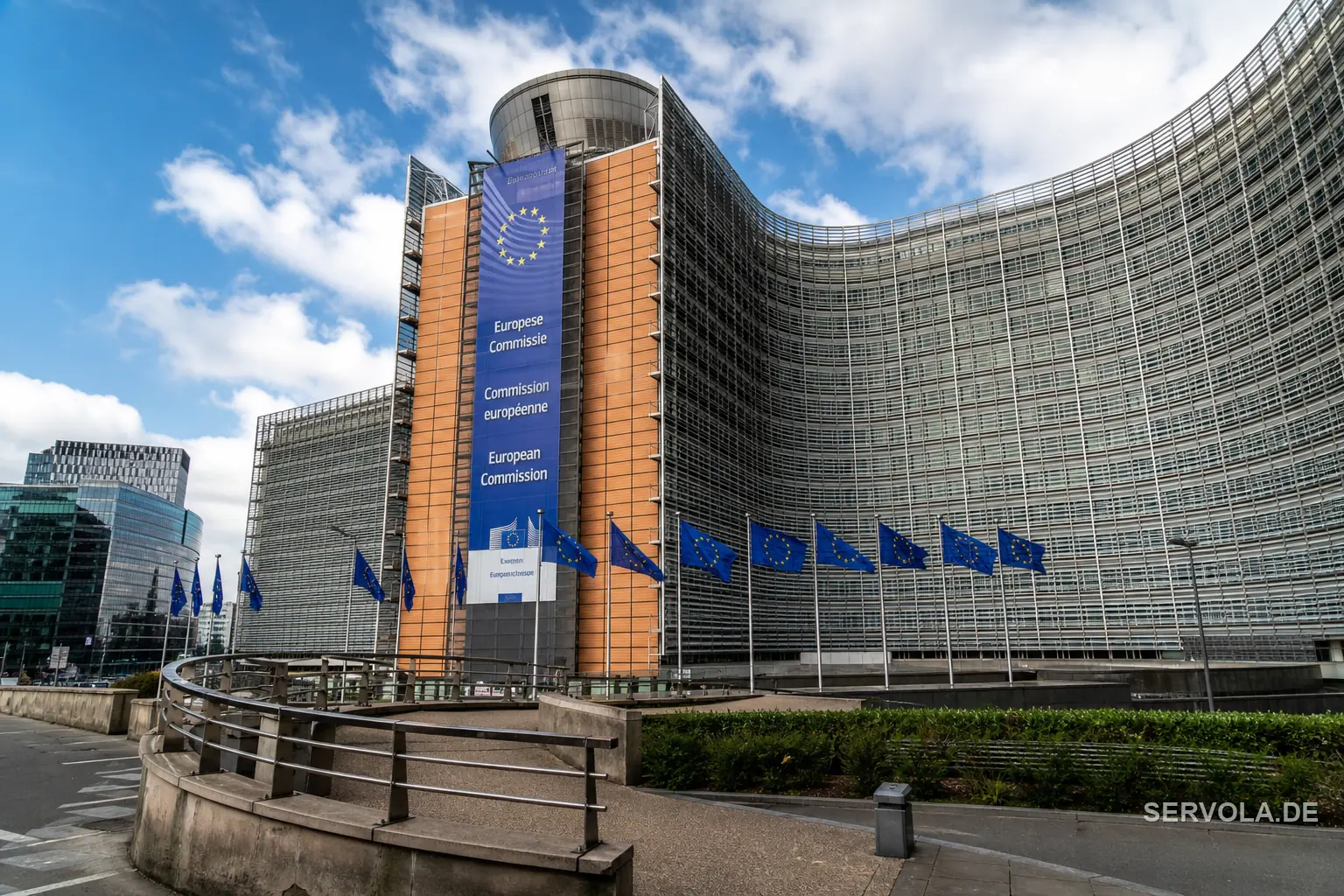
Two decisions, no fine, and a date in January
The European Commission adopted two binding decisions against Google on 16 July 2026, and neither of them is a punishment. One covers Google Android and requires it to open thirteen system features to rival AI assistants. The other covers Google Search and requires Alphabet to share the query, view, click and ranking data it collects to tune its own results. Both are specification decisions, adopted eleven days before the statutory deadline of 27 July.
The distinction matters more than the coverage suggests. The Commission's own press release is blunt about it: specification proceedings are distinct from non-compliance investigations, do not aim to assess whether the gatekeeper has complied, and therefore do not provide for fines. The Commission opened these proceedings on 27 January 2026 on its own initiative, under a heading that described the exercise as assisting Google in complying. Six months later it has produced an instruction manual, not a penalty.
That is the part worth reading twice. Alphabet has been carrying Digital Markets Act obligations since 7 March 2024. What changed today is that the vagueness ended. Article 6(7) of the DMA has always required effective interoperability; Article 6(11) has always required search data access. Brussels has now written down what those sentences mean in features, in data fields, and in dates, which is what makes them enforceable later.
The word missing from the headlines is sell
Google is not being told to give its search data away. The Commission's case documents set a price: beneficiaries pay only the incremental costs Alphabet incurs in sharing the data, plus a reasonable return on capital employed, with a further margin possible in exceptional circumstances. That arrangement runs for five years and is then renegotiable. Three test samples exist to let a buyer look before committing, one small sample free of charge, one synthetic, and a 5% sample under conditions.
What is on offer is more granular than the word sharing implies. The obligation covers query, view, click and ranking data collected for the purpose of optimising Google's search services, delivered daily, at record level, through an API, with availability of at least five years. The query metadata runs to timestamp, location, language, device identifier, input method, and the access point the search came through, which explicitly includes the Chrome address bar, Google Lens, Circle to Search and Gemini itself. Invalid traffic is excluded. Anonymisation is layered and contractual as well as technical: direct identifiers suppressed, long and rare queries suppressed, location and device type generalised, a thirteen-month retention cap on the recipient, no onward sharing, no re-identification attempts, and an independent audit before anyone gets access at all.
So the correct description is not that Brussels opened Google's index. It priced it. There is now a regulated wholesale market in European search data with exactly one supplier, a cost-plus tariff, an audit regime at the door, and a five-year term. Alphabet also keeps a hand on the tap: it may assess whether sharing with a specific third party poses serious cyber security and data protection risks. The Commission, for its part, reserved the right to amend the anonymisation rules if an independent evaluation says they are wrong.
The hotword is the real estate
On the Android side, the fight is over the moment a phone starts listening. The Commission's published enumeration lists thirteen features across four themes, and the first two are the valuable ones. Rival assistants must be able to run always-on hotword detection with their own custom wake words, through the phone's dedicated signal-processing chip, concurrently with the existing Google hotword, and it must work with the screen off and the handset in battery saver mode. They must also get the long-press home button gesture that today is, in the Commission's phrasing, often mapped to Alphabet's Circle to Search.
The rest of the list is the context an assistant needs to be useful rather than decorative. Centralised access to app data held on the device, proactive suggestions of the sort Pixel ships as Magic Cue, ambient data from microphone, camera, screen and speakers, screen automation through the same Computer Control interface Gemini uses, structured integration with Gmail, Calendar, Drive, Photos, Maps and YouTube, access to the system-level on-device models, preferential memory for those models, and permission to run in the background. Access must be free, documented, and available on every Google Android device including those built by other manufacturers.
One clause does most of the work. Access to these features may not be conditioned on the app holding a default role, including the default assistant role. Until now, the way to reach the useful parts of Android was to win the default slot. The Commission has decoupled capability from that slot, which is why Google's objection is framed the way it is. Kent Walker, President of Global Affairs at Google and Alphabet, wrote that the decisions risk undermining vital privacy and security guardrails for millions of Europeans, and that the Android ruling threatens device security by granting external apps sensitive and powerful device permissions. The decision does allow security carve-outs, but only where they are duly justified on transparent, objective, precise and non-discriminatory conditions that also apply to Alphabet's own services. No appeal has been announced.
Chatbots are named buyers
The most consequential sentence in the search decision is the one that says who may buy. Alphabet shall not exclude third-party undertakings, in the Commission's words, such as undertakings providing AI chatbots with online search engine functionality, even where that search engine is provided as part of a broader service. An answer engine with a search function inside it is an eligible recipient of Google's click and ranking data. That is not an interpretation, it is the text.
Read that against what the two Executive Vice-Presidents said and the intent is not subtle. Teresa Ribera framed the decision as helping smaller competitors, search engines, or AI assistants to compete while protecting the user's privacy. Henna Virkkunen was more direct still, saying the measures aim to enable fair competition in the markets for AI assistants on Android and for search engines, and that the hope is to see emerging alternatives to Google Search and to Google's AI services, such as Gemini. A regulator naming a specific product it would like to see challenged is telling you what the file is actually about.
For anyone whose customers arrive through search, this is a structural change rather than a compliance chore. Roughly six in ten mobile users in the European Union are on Android. From January 2027 the model answering a question about your product can be trained and tuned on the same behavioural signal that made Google's answer good, bought at cost. Being found stops being one auction with one set of rules and becomes several answer engines drawing on a common licensed feed, each with its own ranking on top. The competitive moat that is being drained here is not the phone. It is twenty years of knowing what people clicked.
What lands in your plan, and when
Two dates, both from the Commission's own text. Google must start sharing search data with eligible providers from January 2027. Users start benefitting from the Android changes as of July 2027. Nothing in between is public: the case summary refers to conditions and timelines contained in the decisions themselves, which have not been published in full.
Do not confuse this file with the other Google files. The self-preferencing investigation under Article 6(5) is a separate non-compliance proceeding, and that is the one that can carry a fine. Today's decisions cannot. If Google fails to implement them, the Commission's next move is a non-compliance case under Articles 6(7) and 6(11), where the ceiling is 10% of worldwide turnover, rising to 20% for a repeat on the same service, plus daily penalty payments of up to 5% of average daily worldwide turnover. That is the sequence: specify, then enforce. Today was the first half.
The practical instruction is short. If your acquisition depends on Google, put January 2027 in the plan as the date the underlying data stops being exclusive, and July 2027 as the date the phone stops defaulting. Then ask your marketing supplier one question and hold them to the answer: when the assistants can buy the click data, what are we measuring visibility in, and who is doing the measuring.
Read next: Google Just Told You Where To List Your Business Now | Google Escapes Breakup - Brussels Still Watching