What Microsoft Committed To
Scott Guthrie, Microsoft's executive vice president for Cloud and AI, said on 12 October that the Azure Maia family will scale to multi-gigawatt deployments starting in 2027 and become the primary inference system for Microsoft's products and services. Reuters adds that Microsoft plans to deploy potentially more than a million Maia 300 chips next year and expects to spend more than $175 billion in capital expenditure this calendar year.
The chip already in service is Maia 200. Microsoft says it serves production workloads including Microsoft Copilot, with GitHub Copilot and Microsoft Foundry to follow by the end of the year. It runs OpenAI models, Microsoft's own MAI models and leading open-source model families and is being deployed across the United States, Europe and Australia. For built-in AI in Teams, Copilot and Cowork, Microsoft claims up to 1.7 times more tokens per watt than leading GPU infrastructure.
The Spec Sheet In One Table
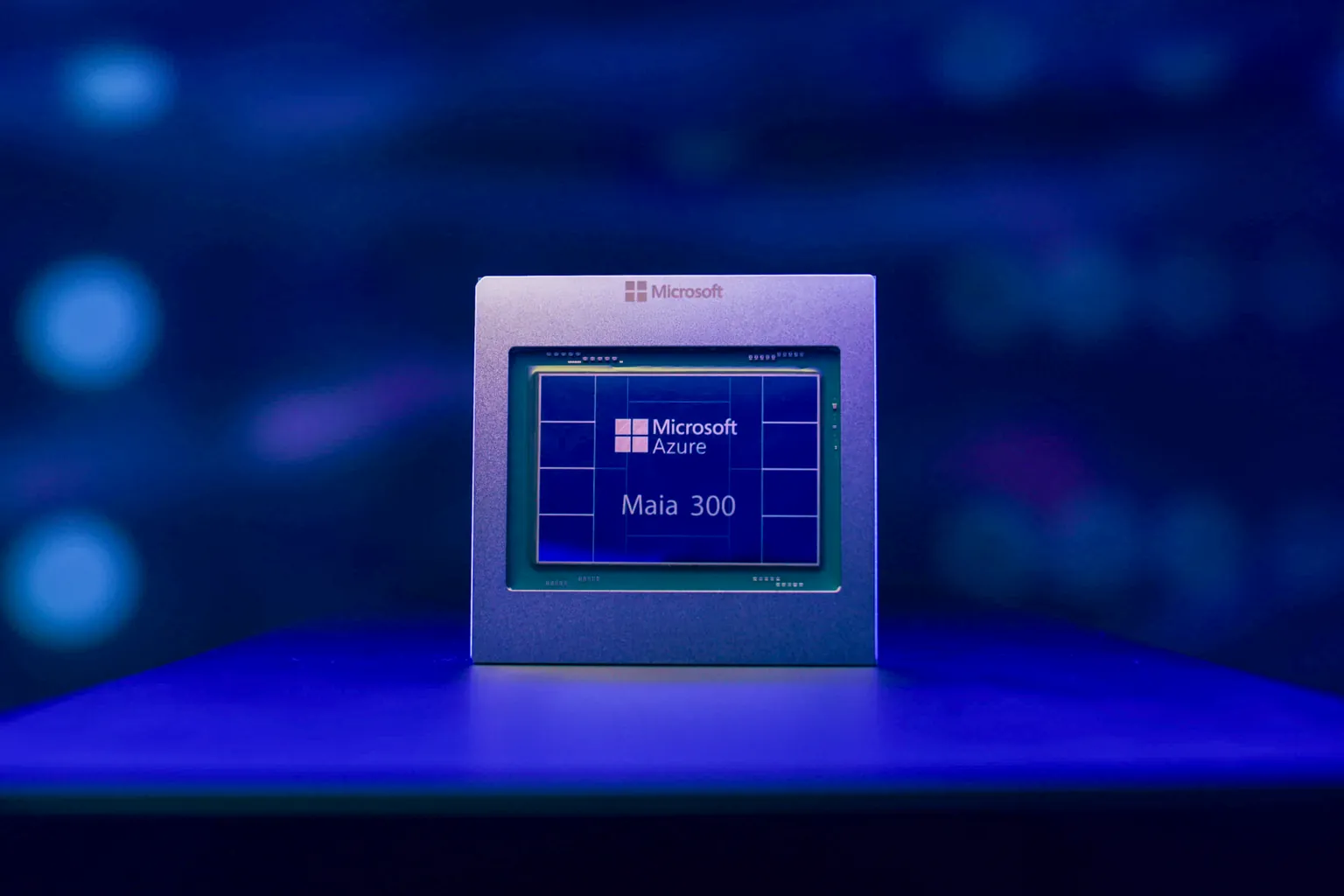
These are the figures Microsoft published for Maia 300, which begins production deployments in 2027.
| Item | Maia 300, per Microsoft |
|---|---|
| Compute chiplets | TSMC N2P process node |
| Memory per chip | 8 HBM4 stacks, 18.0 TB/s peak bandwidth |
| Power per chip | 950 W TDP |
| Rack | 96 accelerators in a 167 kW envelope |
| Rack memory | 27.6 TB of HBM, 1.7 PB/s aggregate bandwidth |
| Efficiency claim | 40 percent more tokens per megawatt than leading GPU-based systems |
| Throughput claim | up to 7 times the rack-scale token throughput of Maia 200 |
Both efficiency claims are Microsoft's own expectations for a chip that is not yet in volume production. Microsoft did not name the GPU systems it compared against, Reuters notes.
The Rack Is The Number To Ask About
More tokens per megawatt does not mean a lighter rack. Reuters puts the Maia 300 rack at about 167 kilowatts for 96 chips, against 142 kilowatts for Nvidia's GB300 rack of 72 GPUs.
| Rack design | Accelerators | Rack power |
|---|---|---|
| Microsoft Maia 300 | 96 | about 167 kW |
| Nvidia GB300 | 72 GPUs | 142 kW |
| Nvidia MGX 1.2 designs | not stated | up to 250 kW |
| AMD Helion reference rack | up to 16 Instinct MI350P GPUs | no rack power figure published |
Nvidia contributed its Vera Rubin rack designs to the Open Compute Project the same day, with liquid cooling at rack level and a liquid-cooled 5,000 ampere busbar. AMD showed Helion, an open rack design for agentic AI, with partner-built versions due in November 2026. The common thread is power and cooling per rack.
Who Keeps The Saving
A chip that serves more tokens per megawatt first lowers Microsoft's own cost to serve. Whether any of that reaches customers is a commercial decision, and the announcement says nothing about it.
Maia capacity is Azure capacity, which is the lock-in side of the story: none of the sources describes Maia as available outside Azure. Colocation customers weighing equally dense racks face a different test, which is how much power and cooling their hall can deliver per rack.
Three Questions Before You Sign
Ask Microsoft whether lower serving cost shows up in per-token prices or Copilot licences at your next renewal, and get the answer in the contract, not in a keynote.
Ask which of your workloads run on Maia and on which models, since Microsoft says Maia 200 runs OpenAI models, its own MAI models and open-source families. Ask any colocation provider for the maximum kilowatts per rack and the cooling type before you plan dense AI hardware.
Read next: Europe's Quantum Hardware Now Compiles Through Nvidia | Microsoft's AI Bill Dropped $15 Billion on Paper Only