The chairman's own arithmetic
On August 14, Chey Tae-won told reporters that finding the right US site has proven difficult for a specific, quantified reason: building one fab in Korea costs about half of what the same fab costs in the United States, because land, power and water all cost more and regulation is stricter. He said SK Hynix has spent over a month reviewing multiple candidate sites without settling on one, and that the company remains willing to build in the US if the underlying conditions - power, water, a skilled workforce and a supply chain - line up.
Those remarks did not arrive as an abstract complaint. They came while global memory demand is, in Chey's own description, a war-like situation: every buyer wants chips, AI computing systems cannot be built without them, and next year will be the toughest supply-demand mismatch the industry has faced. SK Hynix is shifting its own business model in response, moving from selling chips outright toward long-term partnerships built around custom high-bandwidth memory and what the company calls memory as a service, with Nvidia named as its most important customer.
The one site that is already half-built
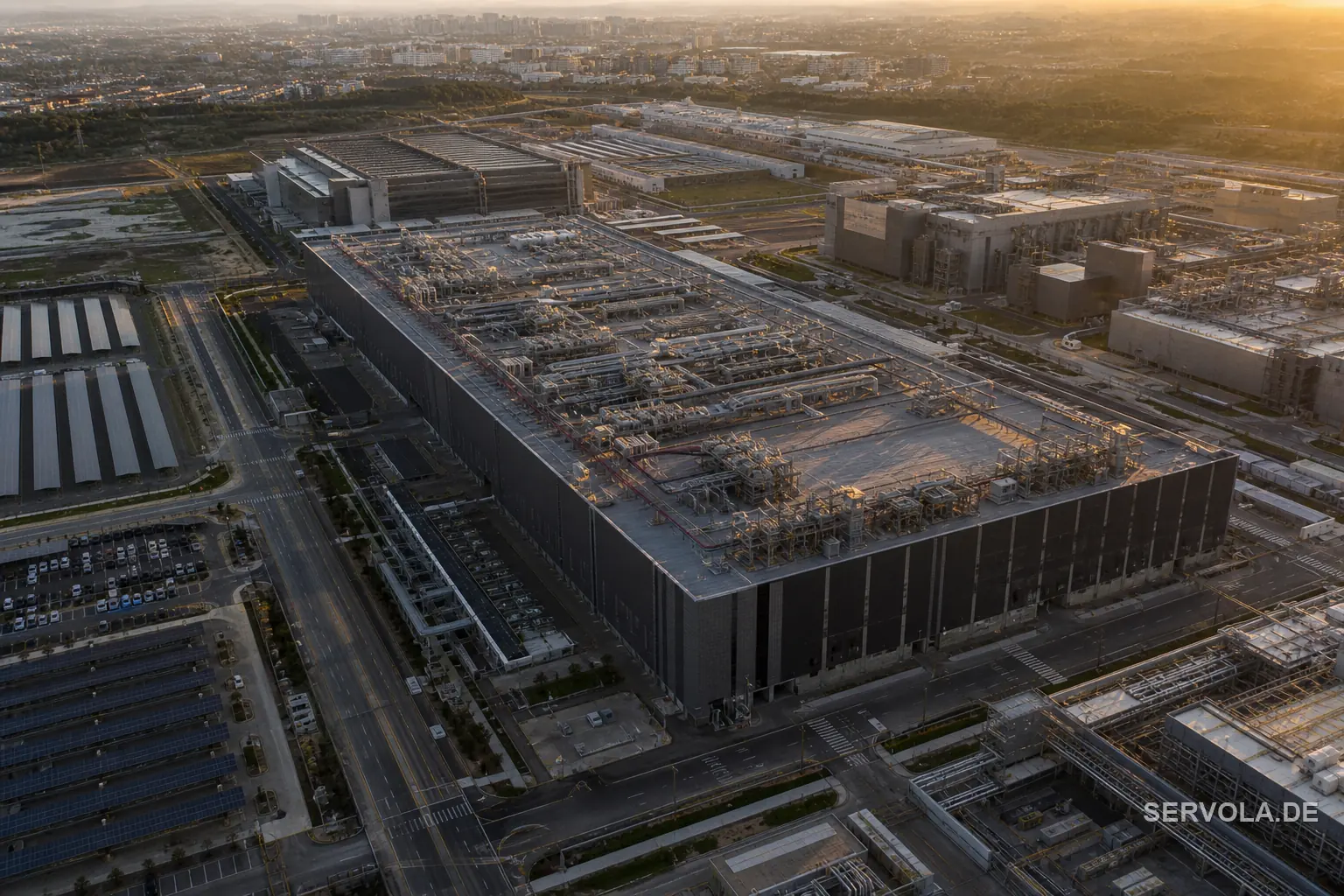
Since a July 22 exclusive report, SK Hynix has reportedly been in talks to acquire Intel's stalled Ohio campus in New Albany rather than break ground on its own site. Intel began construction there in 2022 as a first phase carrying a stated 28 billion dollar price tag, part of a full build-out estimated near 100 billion dollars across a roughly 4.05 million square meter site large enough for eight semiconductor plants. Concrete pouring and steel framing are largely finished; the site has sat idle since Intel pushed its own completion target from 2025 to 2030-2031 amid losses in its foundry business, reported at 2.2 billion dollars last year.
SK Hynix's stated goal, if it proceeds, is to begin front-end memory production there within five years - faster than Intel's own revised timeline for the same buildings. The company has said only that it is looking at various acquisition and investment opportunities and has not decided; the appeal of the site is that most of the expensive, time-consuming construction work Chey just priced at double Korea's cost has already been paid for, by someone else.
What the arithmetic says about reshoring
SK Hynix is not short of capital or intent: nine days before Chey's remarks, its own board approved 38.1 billion dollars for two new Korean fabs, Yongin Y2 and Cheongju M17, describing the memory shortage as a structural shift rather than a cycle. The chairman's US cost complaint, made so soon after that Korean commitment, marks a real distinction: SK Hynix is confident enough in demand to commit tens of billions of dollars to Korea within days, but not yet confident enough in US site economics to do the same on a greenfield US site.
That gap is exactly what the Intel Ohio option is built to close. Washington's push for domestic memory production, including direct appeals from Commerce Secretary Howard Lutnick, runs into the same cost math whether or not SK Hynix ever confirms a deal: a fab that has already had its concrete poured and its steel raised is the only US route that does not require SK Hynix to accept a bill roughly twice the size of its Korean commitments, at the exact moment the company says memory scarcity is at its worst.
Read next: SK Hynix's US HBM Plant Still Needs Korean Wafers | SK Hynix Workers Unionize as HBM4 Ramp Nears