The Studio That Keeps Striking
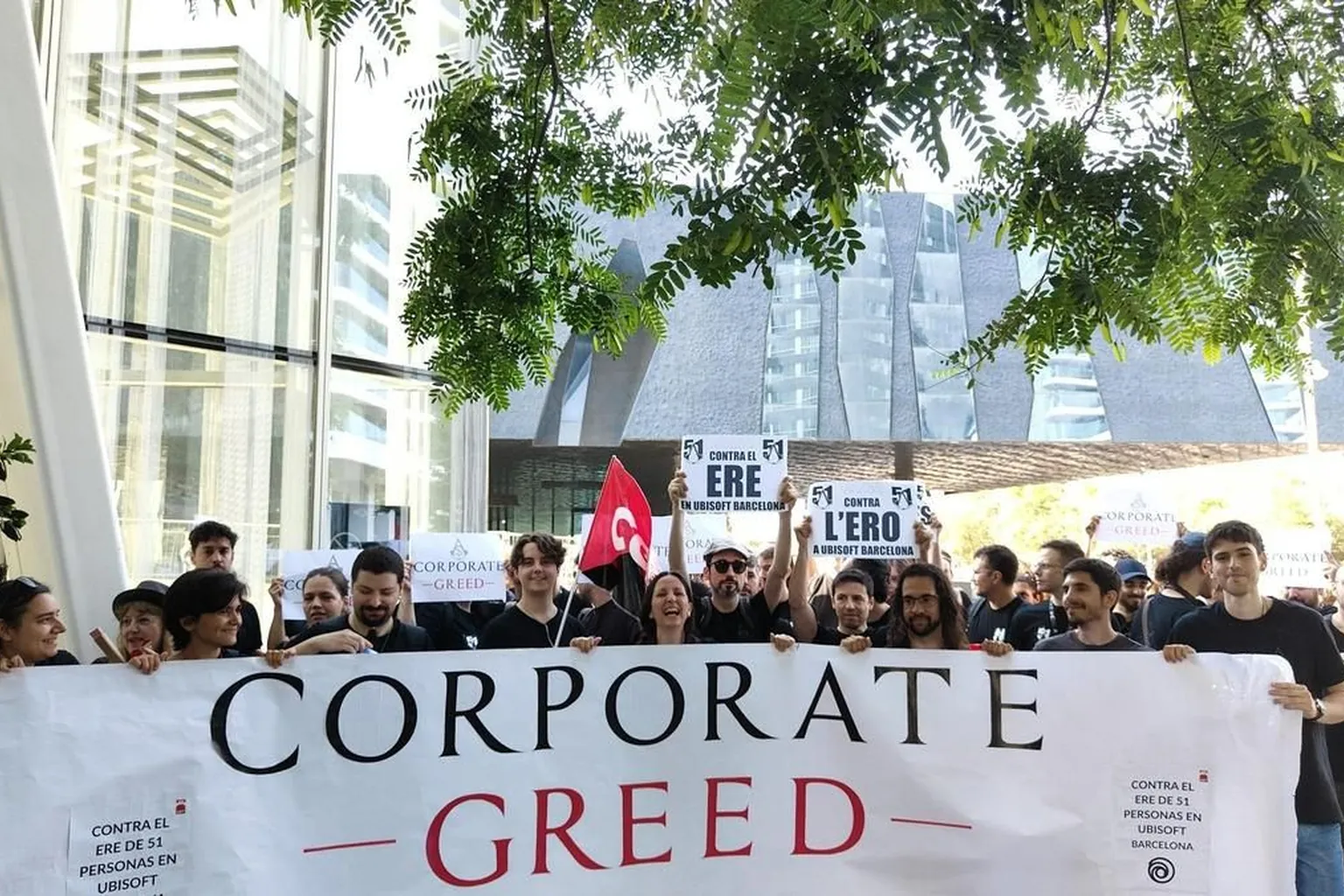
On September 1, roughly half of Ubisoft Mobile Barcelona's staff, about forty of the studio's roughly one hundred workers, walked out and gathered outside the office. The CGT union's video game section, the Coordinadora Sindical del Videojuego, had called it as the first day of an open-ended campaign: three strike days every two weeks, with the next round set for September 16, 17 and 18. The trigger was a company decree ending the studio's hybrid arrangement, which currently guarantees three remote days a week, and replacing it with five days in the office starting January 1, 2027.
Workers are not asking for more remote days than they already have. They are asking that the days they already have stay theirs, in writing, rather than be revocable by a single management memo. "Queremos una negociacion real y queremos volver a tener el teletrabajo blindado como derecho," the union said: real negotiation, and remote work protected as a right, not a favor that can be withdrawn.
A Delay Is Not An Answer
Ubisoft has made exactly one move since the strike was announced in early August: it pushed the mandate's start date back three months, from October 2026 to January 2027. It did this without opening a single conversation with staff representatives, according to reporting from Spanish outlet elDiario.es. Workers' representatives who were told the strike was coming in August say they are still waiting for management to actually sit down.
A later start date changes nothing about what workers are objecting to, which is the decision itself, made unilaterally and then defended by silence rather than a counteroffer. Delaying a deadline reads, to a union watching a company's next move, as buying time rather than reconsidering, and three more months of that same posture is exactly what produced six more strike days on the calendar.
One Company, Four Cities, One Playbook
This is not Ubisoft Barcelona's first labor dispute this year, and it is not even the first at this specific studio. In May 2026, a pan-European Ubisoft return-to-office mandate triggered a walkout involving roughly 1,200 workers across the company's sites. In June and July, Ubisoft Barcelona's main studio struck separately over 51 proposed layoffs, a dispute Servola covered as it happened. September's indefinite strike over telework is a third, distinct action, at the same city, inside four months.
What makes this one different is coordination: the CGT campaign is timed alongside sister unions at Ubisoft sites in Lyon, Milan and Dusseldorf. A concession Ubisoft makes, or refuses, in one city is now visible leverage the others can point to in theirs. Running the identical playbook, announce first, negotiate never, delay when pressed, in four EU markets at once means each repetition teaches every remaining site what to expect next.
What This Means For An EU Employer
Spain treats a written remote-work arrangement as a negotiated condition of employment, not a perk an employer can withdraw by announcement. That is precisely the gap Ubisoft's response has not closed: delaying implementation is an administrative act, while the workers' demand is a negotiating act, and only one of those two has actually happened here. Any employer weighing a return-to-office mandate across multiple EU jurisdictions is watching a live demonstration of what a delay-without-negotiation strategy actually buys, which on this evidence is a longer runway to the identical confrontation, not a resolution of it.
The broader lesson travels well beyond gaming studios. Where remote-work terms sit in a written, collectively negotiated agreement, whether in Spain, France, Italy or Germany, reversing them by memo invites exactly the response Ubisoft is now managing in four cities at once: strikes that do not stop until the negotiation the policy tried to skip finally happens.
Read next: "No More Hand-Written Code": Epic's Late Disney Game | AI-Decompiled Games Now Run Well In A Browser Tab